Most advice about AI automation consulting is backward. It tells you to build faster, show off automations, and “land the client” with demos, which is exactly how consultants end up commoditized against cheap shops and trapped in margin-killing pilots. The money in 2026 is not in faster building. It's in governance-first scoping, retainers with setup fees, and pricing that survives when pilots underperform.
The market is already telling you where this goes. In a 2025 enterprise survey covering nearly 2,000 organizations across 105 countries, 88% reported using AI in at least one business function, up from 78% in 2024, and 79% reported using generative AI specifically, up from 55% in 2024, with enterprise genAI spending reaching $37 billion in 2025 versus $11.5 billion in 2024, a 3.2x year-over-year increase (enterprise adoption and investment trends). That's not a demo market anymore. It's an execution market.
Table of Contents
- Why Most AI Automation Consultants Lose Deals Before They Start
- What AI Automation Consulting Actually Is
- The Client Lifecycle From First Call to Renewal
- Writing a Proposal That Wins on Risk Reduction
- Scoping Engagements the AI Audit Way
- Delivery Templates That Standardize Your Practice
- Pricing Models That Protect Margin and Convert
- The 90-Day Operating Plan and Mistakes to Avoid
Why Most AI Automation Consultants Lose Deals Before They Start
The first mistake is obvious. Consultants pitch build hours before they diagnose the business problem, then wonder why buyers compare them to offshore automation shops on price alone. Once the conversation becomes “How many automations can you ship?”, the work is already commoditized.
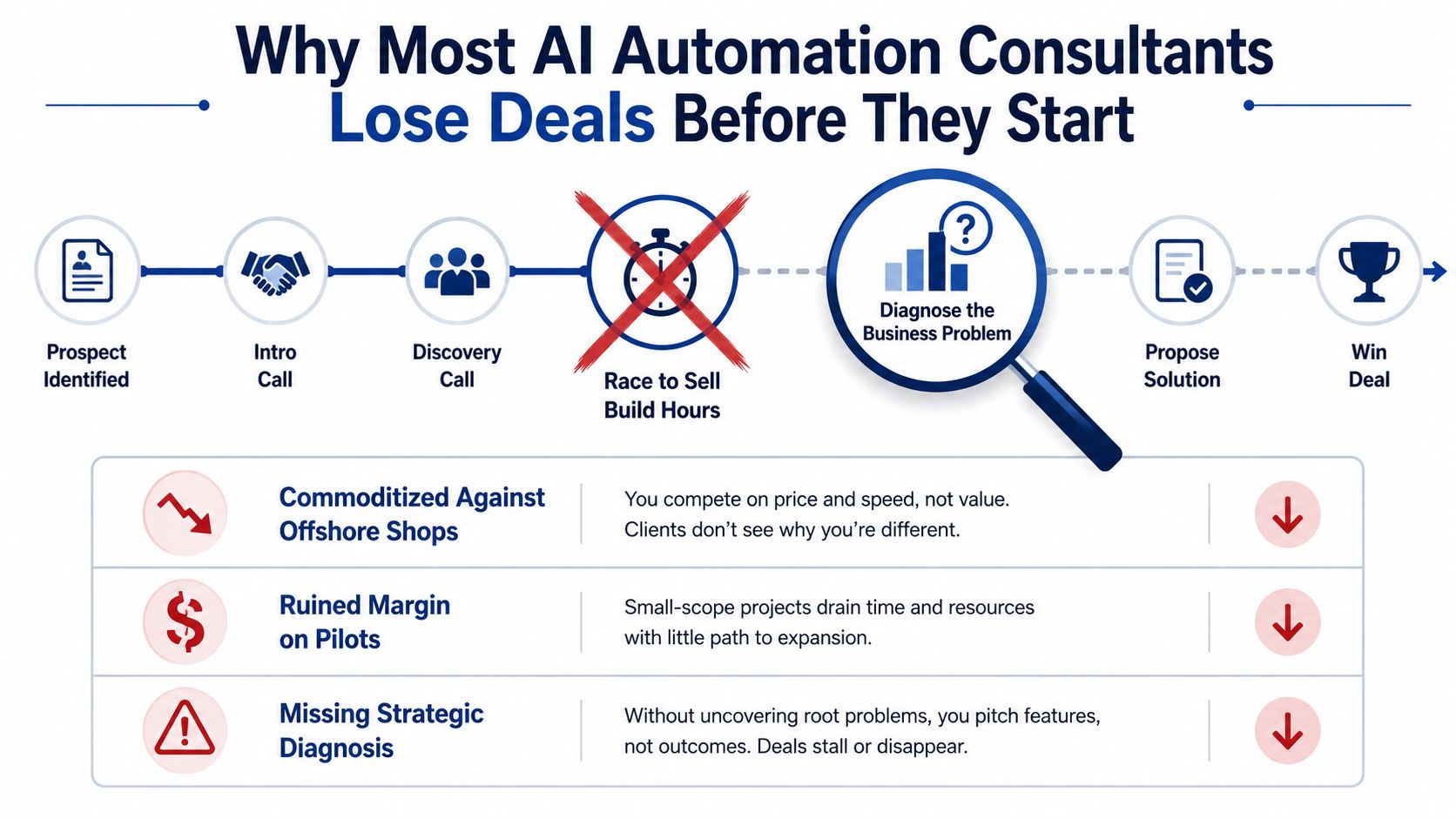
Start with an AI audit. That product sells diagnosis instead of labor, which is the cleanest way to avoid an hourly-rate cage match. It also forces sharper questions before anyone talks about tools, and those questions decide whether a deal gets saved or dies.
The three warning signs
Practical rule: if the buyer can't name the process, the executive sponsor, and the decision criteria, don't quote the build.
- Vague use cases. “We want to use AI” is not a project. It means the client has not mapped the workflow, the exception paths, or the failure modes.
- No executive sponsor. If the person buying your work cannot clear policy, budget, and cross-team friction, the engagement will stall the first time it touches operations.
- Hourly-rate comparison shopping. When a prospect asks how your rate stacks up before they have agreed on scope, they are not buying transformation. They are buying time.
Diagnosis-first positioning changes the conversation. A strong consultant sells the decision that comes before the build, then uses that decision to define the build. It also protects your margin when the client discovers that automation touches messy data, legacy systems, and governance rules they hoped to ignore.
The gap is already visible in enterprise adoption and investment trends. Analysts have shown that broad AI usage does not automatically turn into scaled deployment. Buyers are not short on curiosity. They are short on a safe path from experimentation to production.
What AI Automation Consulting Actually Is
AI automation consulting is not chatbot development, and it's not generic strategy work with a model slapped on top. It sits between business process design and implementation, then carries responsibility through deployment and stabilization. If you're only doing prompts, you're a specialist. If you're only doing slideware, you're not close enough to operations.
The four-layer capability stack
- Diagnosis. Map the workflow, bottlenecks, and exception handling. Deliver an audit report that identifies what should change and what should be left alone.
- Solution design. Translate the business problem into architecture, tooling, guardrails, and handoffs. The deliverable here is the design doc, not a promise.
- Implementation. Ship the working automation, integration, or agentic workflow. The system becomes real.
- Managed optimization. Monitor, tune, and govern the workflow after launch. The runbook and KPI dashboard matter as much as the build.
That stack is what allows a consultant to charge premium fees. The buyer isn't paying for code alone, they're paying for a controlled path from problem to adoption. A consultant who owns diagnosis and managed optimization can also defend pricing better than someone who only offers implementation.
A lot of adjacent services blur this line. Chatbot shops build interfaces. Dev agencies write software. Fractional CTOs coordinate technology leadership. Pure strategy houses produce recommendations and leave the messy parts to somebody else. AI automation consulting becomes a real category only when it ties those pieces together, or deliberately scopes itself to one defined layer.
Here's the simplest way to audit your positioning. If you can't point to the audit report, the architecture doc, the working automation, and the runbook with KPIs, you're not offering a complete consulting practice. You're offering fragments.
| Service Type | Primary Deliverable | Billing Model | Conflict With Consulting |
|---|---|---|---|
| Chatbot shop | Conversation interface | Project or per-bot fee | Often too narrow |
| Dev agency | Custom software build | Time and materials or fixed-fee | May skip business diagnosis |
| Fractional CTO | Technology leadership | Monthly retainer | Lacks hands-on delivery depth |
| Pure strategy house | Recommendations deck | Advisory fee | Weak implementation handoff |
| AI Automation Consulting | Audit, build, and optimization | Hybrid, milestone, or retainer | None if scoped correctly |
That's the standard. Anything less is either a tool service or a strategy memo with a nicer landing page.
The Client Lifecycle From First Call to Renewal
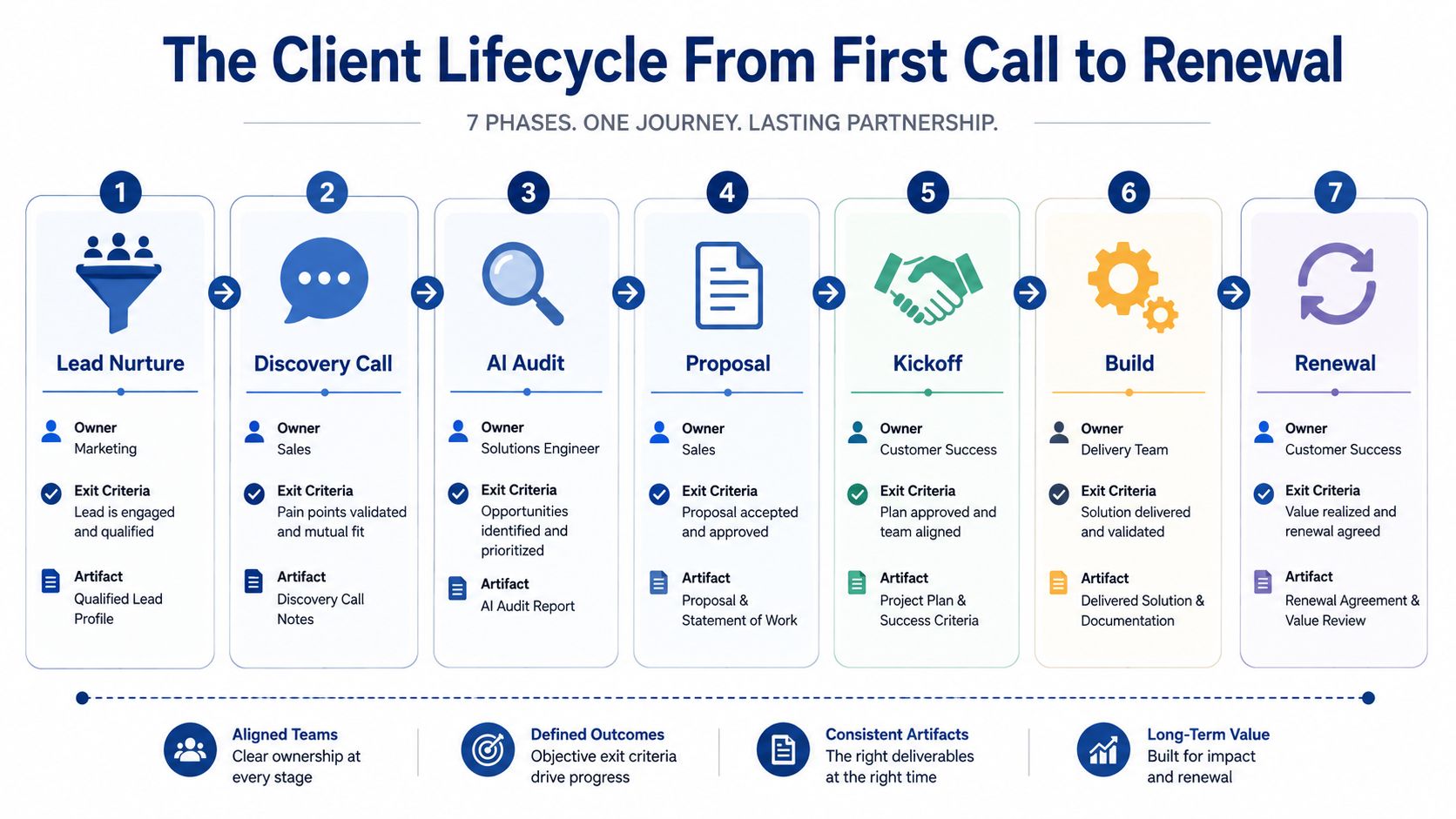
The cleanest client journey starts long before the proposal. The consultant owns the process from first touch to renewal, but each phase has a different artifact, owner, and exit criterion. If you treat all seven phases like one generic sales motion, you'll lose control of scope and revenue.
Where the handoffs break
The first break point is discovery to AI audit. If the discovery call ends with a vague “send me a proposal,” you've already lost the chance to define the problem correctly. The fix is to make the audit the only acceptable next step when the use case isn't crisp.
The second break point is audit to proposal. Consultants get tempted to over-explain the roadmap and underwrite risk with their own margin. Don't. Use the audit to produce a prioritized opportunity register, then propose only the top one or two items with explicit assumptions and dependencies.
The third break point is build to renewal. Most consultants wait until the last week of delivery to discuss continuity, which is too late. Renewal should be triggered by the client's willingness to keep the governance cadence, expand the automation surface area, or move from build support into managed optimization.
A useful operating rule is to attach the retainer after the client sees the roadmap, not after the final build is finished. That's when they've seen the opportunity set and understand that automation is a managed system, not a one-off project.
If the client can't point to the next workflow they want automated, renewal is a conversation about maintenance, not expansion.
Writing a Proposal That Wins on Risk Reduction
Most proposals lose because they sell deliverables instead of de-risked decisions. Buyers don't need another promise that something will be built. They need a contract structure that keeps the project from turning into a sunk-cost exercise.
The six parts procurement can defend
First, frame the executive summary as risk reduction. The client is not buying shiny automations, they're buying fewer unknowns around process reliability, adoption, and governance.
Second, define phased milestones with explicit acceptance criteria. Each milestone should say what is being delivered, what counts as done, and what happens if the dependency isn't available.
Third, include a dependency register. List the inputs the client must provide, the systems that must be accessible, and the decision-makers who must sign off. This prevents late-stage blame games.
Fourth, add a change request path. Scope changes happen. The contract should say how they're priced, approved, and scheduled.
Fifth, lock down IP and data ownership. Buyers need to know who owns the workflows, the prompts, the integrations, and the outputs.
Sixth, include a kill clause so either side can exit cleanly when the economics or governance conditions stop making sense.
A proposal that uses this structure usually wins for a simple reason, it respects the fact that pilots underperform often enough that the contract has to be survivable. That's especially true when the client is comparing vendors and doesn't yet know which workflow will carry into production. For a practical sales frame that aligns with this style of proposal work, see SeanNoCode's sales techniques course.
| Component | Typical Proposal | Risk-Reducing Proposal |
|---|---|---|
| Executive summary | Feature list | Business risk reduction |
| Milestones | Broad phases | Phased delivery with acceptance criteria |
| Dependencies | Hidden assumptions | Explicit client responsibilities |
| Change handling | Informal email approvals | Formal change request path |
| Ownership | Vague rights language | Clear IP and data clauses |
| Exit terms | Hard to unwind | Clean kill clause |
The strongest proposals also tie every milestone to something the client already tracks, like hours saved, tickets deflected, or lead-to-quote time. Don't sell “model improvements.” Sell a decision the buyer can defend.
Scoping Engagements the AI Audit Way
Treat scoping as the conversion engine, not a free workshop. A fixed-fee AI audit does three jobs at once. It qualifies the client, creates a roadmap, and gives you a paid bridge into build work.
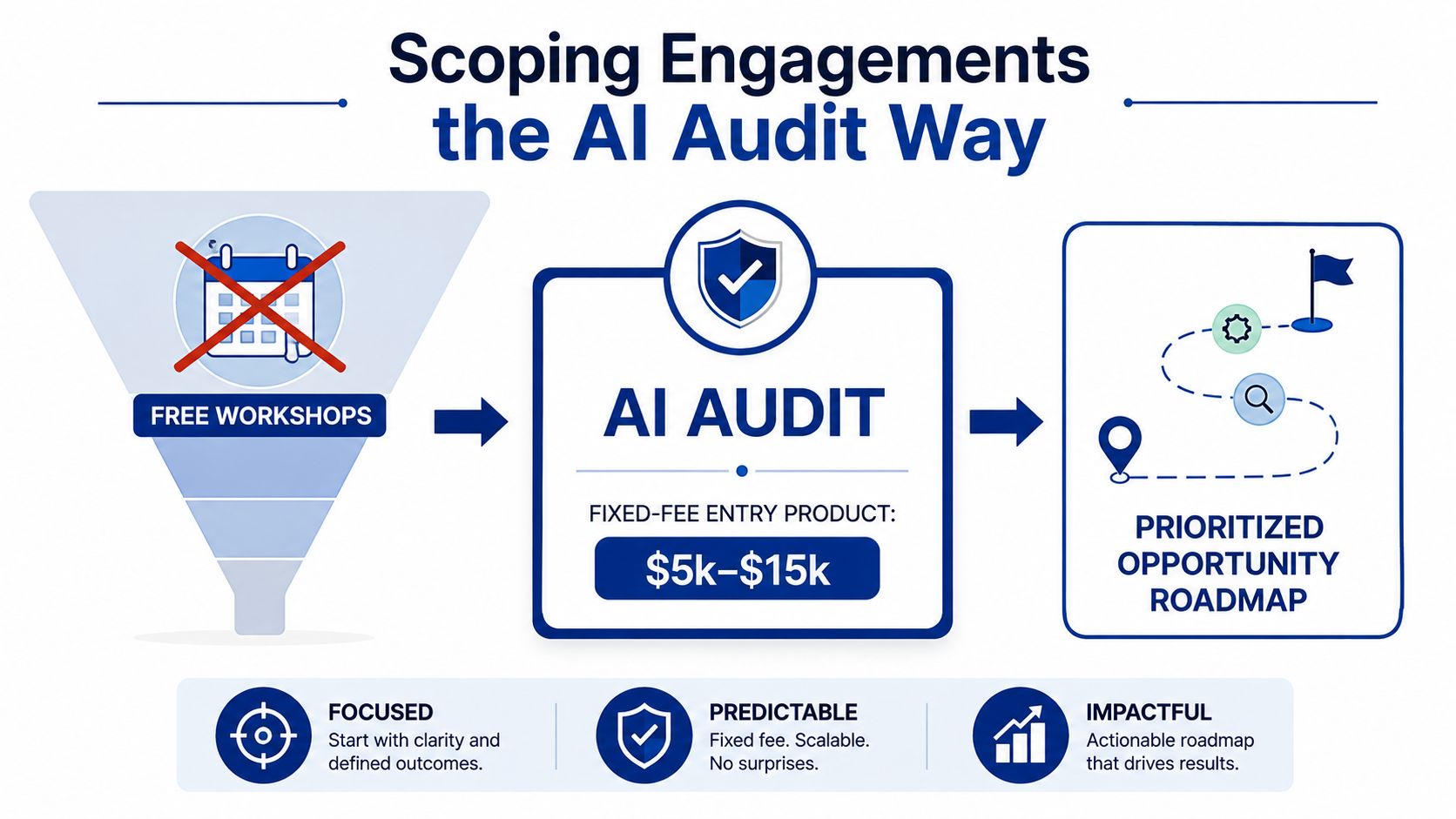
The audit needs a hard boundary. Free workshops blur discovery with sales, and that's where margins go to die. The cleaner move is to charge separately for diagnosis, then use the output to scope the build. SeanNoCode's audit framework is one example of how that entry product can be packaged.
The week-long audit flow
Start with intake. Collect the process description, current tools, owners, and constraints before you ever meet live.
Move to process mapping. Draw the workflow as it exists, including exceptions, handoffs, and manual interventions.
Then do workflow instrumentation. Identify where data exists, where it breaks, and where rework happens.
After that, run opportunity scoring. Rank each use case by business value, implementation difficulty, and governance risk.
Finish with an executive readout. Deliver a prioritized opportunity register, a data readiness score, a build-versus-buy view for each workflow, and a 90-day roadmap.
That package converts well because it makes the next step obvious. You don't need to push the client into a giant build. You attach a scoped SOW to the top one or two opportunities and hold delivery capacity with a fee while budget approval moves through the client's side.
The audit is also where you separate discovery from implementation in your pricing model. That separation matters. If you blur them, you'll end up doing uncompensated analysis inside build work, and the margins will disappear before the automation is even live.
Practical rule: if the audit doesn't end with a ranked list and a clear recommendation, it was a meeting, not an engagement.
Delivery Templates That Standardize Your Practice
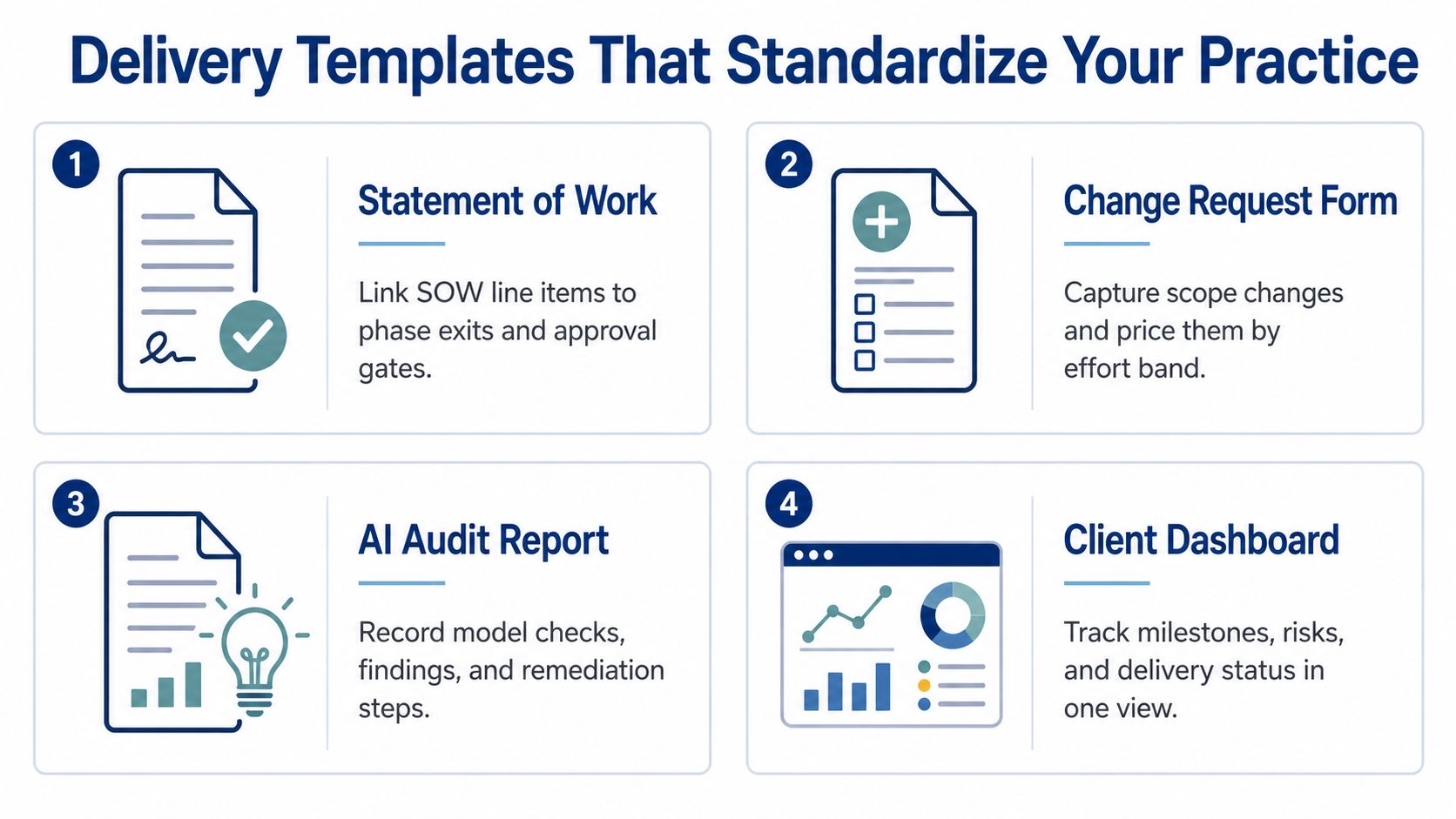
A repeatable practice runs on documents, not vibes. If every project is invented from scratch, you'll spend your time renegotiating scope instead of shipping systems. Standard templates are what let a solo consultant or small team act like a real delivery org.
SeanNoCode also provides workflow training and templates, which is useful if you want a reference point for how to standardize delivery without reinventing every artifact.
Four templates that should exist on every engagement
- Statement of Work. Every line item should map to a phase exit. If a task doesn't move the project toward a signed-off deliverable, it doesn't belong in the SOW.
- Change Request Form. Price scope creep by effort band, not by apologizing in emails. A request like “add Slack notifications” becomes a small fixed-fee micro-engagement with a defined impact on timeline.
- Acceptance Criteria Checklist. Don't ask the client if they “like it.” Ask whether the automation meets the pre-agreed conditions for sign-off.
- Governance Cadence Document. Define weekly standups, monthly steering meetings, and quarterly business reviews. Spell out decision rights, escalation paths, and the kill criteria that justify stopping a build before it becomes a write-down.
The change request form does more than protect margin. It trains the client to think in scopes, not favors. A small request that seems trivial in a Slack thread can consume a dev day, break a dependency, or trigger testing work the buyer never saw.
Governance documents matter just as much. If no one knows who can approve a workflow exception, the automation will stall the first time it hits edge cases. You want a named decision-maker, a documented escalation path, and a rule for when the system should stop itself and ask for human review.
Pricing Models That Protect Margin and Convert
There are three pricing models worth mastering, and only one of them works well in every situation. The wrong choice doesn't just hurt revenue. It makes the client relationship harder because the contract stops matching the risk.
| Model | Margin Profile | Cash Flow Timing | Scope-Creep Risk | Ideal Client |
|---|---|---|---|---|
| Retainer plus setup fee | Strong if utilization stays tight | Upfront setup, recurring monthly cash | Moderate | Mid-market operations leaders |
| Fixed-price milestone | Good if scope is controlled | Paid by phase or milestone | Lower when acceptance criteria are strict | Regulated enterprise buyers |
| Outcome-based pricing | High upside, uneven reality | Delayed until measurement period closes | High unless gated carefully | High-confidence, measurable use cases |
What to use and when
Retainer plus setup fee is the core offer for most consultants. It gives you cash up front, funds discovery and implementation, and creates room for managed optimization after launch. It also fits clients who need ongoing support rather than a one-and-done build.
Fixed-price milestone works best when the client wants risk transfer and clean procurement language. Enterprise buyers usually prefer this structure because it makes budget approval and vendor comparison easier.
Outcome-based pricing should stay small and disciplined. Use it only where measurement is clear, the baseline is known, and the client can wait through a real observation window before judging success.
One workflow automation case study reported a 35-person professional services firm that cut onboarding from 11 days to 48 hours, removed 22 hours/week of manual work, and achieved 370% first-year ROI on an $18,400 investment, while also warning that realized value has to be adjusted for adoption rates, manual fallbacks, downstream cleanup, and whether saved capacity is redeployed (workflow automation case study). That's the right way to think about pricing, too. Value only counts when the client can capture it.
My recommendation is a 60/30/10 mix by revenue, with 60% from retainer-plus-setup, 30% from fixed-price expansion builds, and 10% from outcome bonuses tied to quantifiable wins. Keep the outcome piece small enough that it rewards performance without putting the whole practice at risk.
The contract clauses that survive procurement review are straightforward, defined measurement method, data access and baseline responsibility, and a clean exit or rebaseline mechanism.
The 90-Day Operating Plan and Mistakes to Avoid
Stop improvising. A 90-day operating plan forces discipline, gives you a real test of the offer, and keeps delivery from drifting into custom work that never compounds.
Days 1 to 30
Package the AI audit as a fixed-scope entry product in the $8K to $15K range. Write one proposal template that fits on four pages, then publish one case study that shows how you diagnose problems before you build anything. That positioning matters more than another feature list.
Days 31 to 60
Run two paid audits at the same time and convert at least one into a build engagement. Put the delivery templates to work on the next project, with the SOW, change request, acceptance checklist, and governance cadence all in use from day one.
Days 61 to 90
Shift the mix toward retainer plus setup. Review pipeline weekly, and reserve 10% of revenue for outcome bonuses only where the measurement window is clear and the client can observe the result without guesswork.
The mistakes that kill an AI automation practice are predictable:
- Selling builds before diagnosis. You turn yourself into a commodity vendor.
- Underpricing audits. You train the market to treat scoping as free labor.
- Accepting open-ended scope. Every “quick change” eats margin.
- Skipping governance. The workflow breaks as soon as exceptions show up.
- Chasing outcome-only contracts. You absorb too much unpriced risk.
- Treating retainers as optional. You leave post-launch value on the table.
- Ignoring renewal signals until the last week. You force a bad sales cycle back onto the client.
One thing still matters here. As noted earlier, buyer interest in GenAI is already high, but enterprise rollout still stalls on process, ownership, and measurement. That gap is the consulting opportunity. The consultants who win are the ones who make the work operational, price for setup and reuse, and keep governance in the scope from the start.