A long-running benchmark says acquiring a new customer typically costs 5 to 8 times more than retaining an existing one, and retention gains can lift profits by 25% to 95%. In AI automation services, that changes the whole playbook. The first sale matters, but margin often comes from how well you onboard the client, reduce friction, and turn delivery into a repeatable relationship. A strong outreach message sets the right expectation, then the first 90 days act like a filter that keeps avoidable churn from draining the account.
Table of Contents
- Understanding Acquisition and Retention Economics
- Defining Acquisition and Retention Concepts
- Crafting Outreach and Positioning Strategies
- Streamlining Client Onboarding Workflows
- Enhancing Account Management to Boost Retention
- Case Studies of AI Automation Client Success
- Measuring Outcomes and Iterating Processes
Understanding Acquisition and Retention Economics
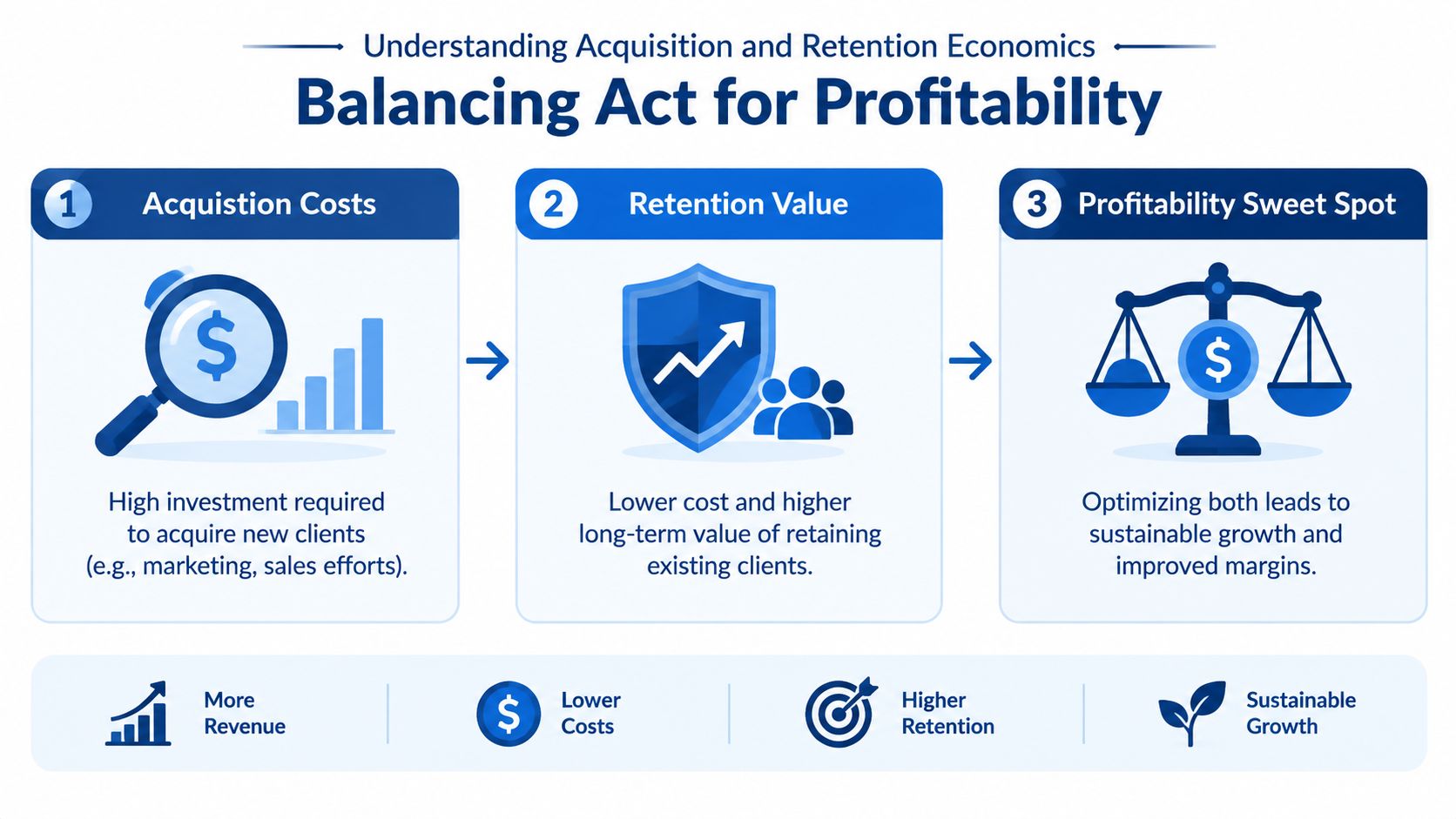
A new client rarely costs the same as an existing one to serve well. Winning the first deal usually means proposal writing, sales calls, onboarding setup, and a period where trust is still being built. Retained clients already understand your process, so the work can shift from proving competence to growing the account.
That difference matters for AI automation consultants and small agencies. Acquisition spending goes into outreach, sales activity, and onboarding. Retention spending goes into customer success, support, and relationship management. If delivery keeps restarting trust from zero, each project leaves less room for profit.
Practical rule: if each new client makes delivery harder, retention is probably underfunded.
For consulting-style businesses, the pattern is easy to miss. A first project often includes scoping, education, and setup. Later projects can reuse the same delivery patterns, which lowers friction and protects retention. That is why retention supports margins. It reduces pressure to replace lost revenue with constant new-logo hunting, and it gives the business more room to raise lifetime value without raising acquisition spend.
A useful way to read the economics is through a bucket with a slow leak. Acquisition fills the bucket. Retention plugs the holes. If a team keeps pouring in new leads without fixing churn, growth may look active, but it stays fragile.
Defining Acquisition and Retention Concepts
The easiest way to understand client acquisition and retention is to treat the business like a lifecycle, not a funnel. One side of the lifecycle brings people in. The other side keeps the relationship useful, profitable, and stable.
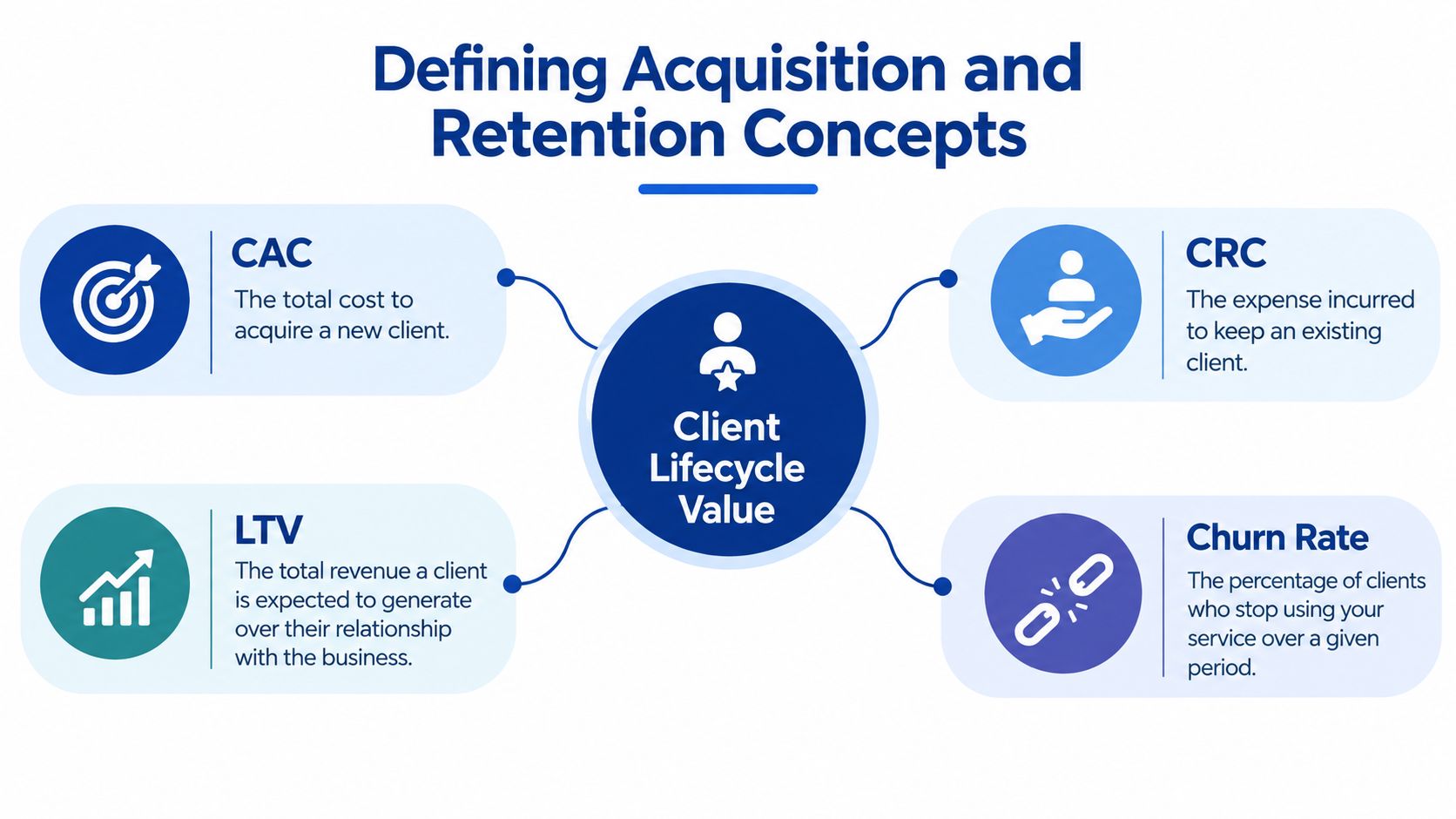
CAC means Client Acquisition Cost, the total cost of winning a new client. CRC means Client Retention Cost, the expense of keeping an existing client engaged and renewing. LTV means Lifetime Value, the revenue a client generates over the full relationship. Churn rate is the share of clients who stop using your service over a given period.
Why these metrics belong together
These numbers don't live in separate dashboards for no reason. CAC tells you what it costs to start a relationship. LTV tells you what that relationship can earn over time. CRC shows whether you're investing enough to prevent avoidable churn, and churn rate reveals where the client experience is breaking down.
The selling side also matters. The probability of selling to an existing customer is 60% to 70%, compared with 5% to 20% for a new prospect (Markinblog customer loyalty statistics). That gap explains why renewals, upsells, and referrals can feel much more predictable than chasing fresh leads. Existing clients already understand your process, so the next conversation starts with trust instead of skepticism.
A simple analogy for consultants
Think of CAC as the cost of opening a door. CRC is the cost of keeping that room comfortable so the client wants to stay. LTV is everything the client spends while they're inside. If you ignore CRC, you may keep opening doors, but a lot of people will walk back out before the project becomes fully profitable.
The best dashboards don't separate growth and retention. They show how one affects the other.
Crafting Outreach and Positioning Strategies
Strong outreach starts before the first message is written. In AI automation, the best-fit clients usually share a few traits, they have repeated manual work, a clear operational bottleneck, and enough urgency to fund implementation. If your positioning speaks to everyone, it usually lands with no one.
Start with the right client profile
Build your ideal client profile from observable details, not guesses. Look at industry, team size, workflow complexity, and where the manual effort sits. A founder who needs lead routing is not the same buyer as a head of operations who needs document automation, even if both say they want “AI.”
Match the channel to the buying behavior
Some buyers respond to LinkedIn because they are already in a professional research mindset. Others need a cold email that names the painful bottleneck in one sentence. Industry events, podcasts, and partner referrals work better when trust is the primary barrier rather than the offer.
Write the message in concrete terms. State the workflow you improve, the risk you remove, and the operational result the client can expect. Avoid vague claims about transformation. Buyers in this space have seen too many empty promises.
Keep the offer tight enough to buy
A confusing offer slows the sales cycle and makes onboarding harder later. Clear scope wins because it sets the tone for delivery. If you want a practical framework for this part of the process, SeanNoCode's sales training is one option among several resources that focuses on client conversations and offer clarity.
Independent 2026 benchmarks report that the median CAC:CRC ratio across 16 industries is 4.7:1, and top performers achieve LTV:CAC ratios above 5.6x (Cydcor benchmarks). That is a reminder that outreach is only half the equation. If the backend experience is weak, you can buy leads efficiently and still lose money on the relationship.
Positioning rule: promise fewer things, but promise them in a way your delivery team can repeat.
Streamlining Client Onboarding Workflows
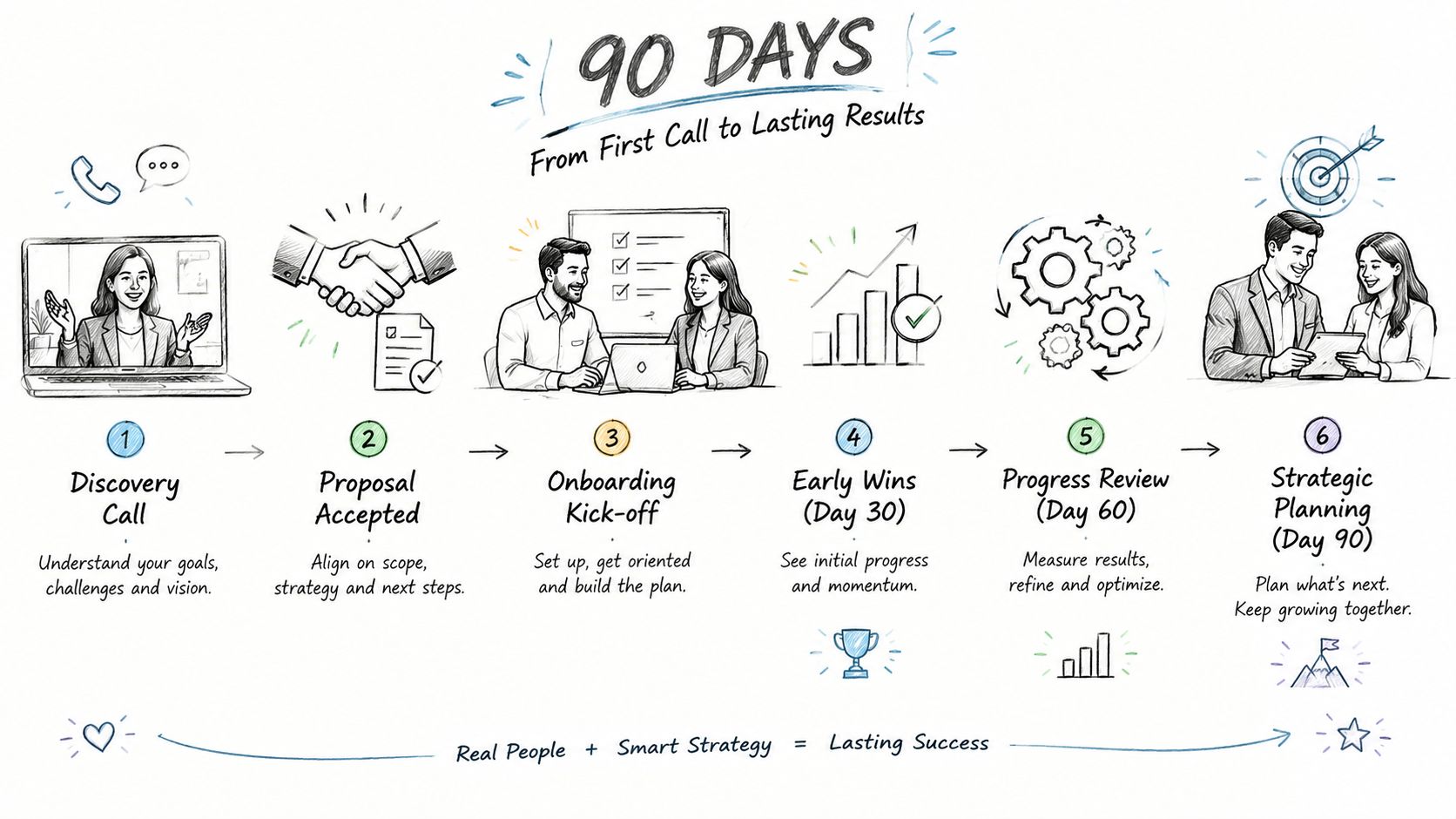
The first 90 days decide a lot more than most consultants want to admit. A 2026 B2B retention report found 43% of client churn occurs in the first 90 days, and 45% of organizations identify onboarding as a weak point (Moxos retention report). That makes onboarding less like a welcome packet and more like the main retention system.
Build the handoff before the handoff happens
Sales should not disappear the moment the contract gets signed. The delivery owner needs the promise that was made, the timeline that was sold, and the risks that were already discussed. If the client hears one story in sales and a different story in delivery, trust drops fast.
A good workflow starts with a written handoff note. It should include the client's main goal, the exact scope that was agreed, the first milestone, and the person responsible for approvals. That document becomes the bridge between excitement and execution.
Use the first 90 days to create proof
The early phase should produce one visible win quickly, even if the full automation takes longer. That could be a cleaned-up workflow, a working draft, a reporting shortcut, or a small automation that saves the client time right away. The point is to make progress visible before doubt starts filling the gap.
For teams that need standard operating procedures, SeanNoCode's business SOP materials fit naturally here because structured checklists reduce ambiguity during delivery. They're not a substitute for good judgment, but they do help teams stay consistent when multiple people touch the same client.
Keep escalation paths obvious
Problems don't hurt retention when they're handled early and clearly. They hurt retention when the client has to guess who owns the issue. Set an escalation route, define response expectations internally, and make sure the client knows what happens when something slips.
A useful test is simple. If a client gets confused during week two, can your team explain the next step without improvising? If the answer is no, the onboarding workflow still depends too much on memory and too little on process.
Enhancing Account Management to Boost Retention
Once onboarding is stable, account management becomes the main system for protecting retention. The account manager keeps the project connected to business results, so communication does not disappear after delivery. A client who hears from you only when something breaks is more likely to see you as a vendor than a long-term partner.
Make reviews a habit, not a rescue mission
Regular account reviews should examine what shipped, what changed in the workflow, and which business objective comes next. They also give both sides a scheduled place to identify scope drift. If requests keep expanding beyond the agreed plan, use a clear change-control process instead of relying on goodwill.
A review cadence works like a maintenance schedule for the relationship. It creates a predictable point for discussing value, risks, adoption, and next steps before frustration becomes urgent. In automation projects, that visibility matters because clients may not see the testing, monitoring, and exception handling happening behind the scenes.
Account management should also connect outreach promises with the first 90 days of delivery. If your sales message promises faster intake, easier handoffs, or fewer manual tasks, each review should show whether the relevant workflow is producing that result. This connection helps prevent early churn because the client can compare the original reason for buying with visible progress.
Use expansion plans with discipline
Expansion should follow real usage. When one workflow is operating reliably, the next opportunity might be a reporting layer, a handoff automation, or a rollout to another department. The proposed work should reflect how the client is already operating, not an internal sales target.
Retention supports profitable growth because repeat work spreads delivery effort across an existing relationship. That makes recurring engagements attractive for consulting and automation services, where a trusted client already understands your process. The account manager's job is to identify the next useful problem, then explain why solving it now fits the client's operations.
Standardize delivery so repeat work gets easier
Templates, review notes, and change-control forms make account management more consistent. They also lower the effort required for future engagements because the team can reuse proven steps instead of rebuilding the delivery process. Documentation gives the client a stable experience even when different team members handle the work.
Useful filter: if a client request requires rewriting your process from scratch, treat it as a separate scope rather than accepting it casually.
The goal is confidence. Consistent updates, clear ownership, and predictable execution show the client that the automation is being managed after launch, not abandoned after the first win. That trust makes renewal and carefully chosen expansion easier to discuss.
Case Studies of AI Automation Client Success
One independent consultant I worked with started with a simple outreach angle. Instead of pitching “AI transformation,” he targeted operations managers who were drowning in repetitive intake tasks. The email named the exact workflow, described the manual bottleneck, and offered a short diagnostic call. That specificity got replies because it sounded like the sender understood the job, not just the technology.
His onboarding was equally disciplined. He used a written kickoff checklist, got approvals on the first workflow before touching the rest, and sent a brief progress note after each milestone. The lesson wasn't that the automation itself was magical. It was that the client felt the project had a map.
A small agency took a different path. They won work through LinkedIn posts that explained common workflow mistakes in plain language, then moved qualified prospects into a short proposal with a fixed scope. After that, they ran a weekly account review for the first month and then shifted to a lighter cadence. The team noticed that clients asked for fewer random changes once the early rhythm was clear.
That same agency also learned a hard lesson. Whenever they sold too broad an “AI package,” onboarding slowed down because the client didn't know what success looked like. When they narrowed the offer to one business process at a time, delivery became easier to explain and easier to renew. For teams exploring structured systems around that kind of workflow, SeanNoCode's AI agent and workflow training is one practical reference point.
A third example came from a solo automation builder serving a niche professional-services firm. He focused on one pain point, document routing, and framed the project as an operational fix rather than a technology demo. After launch, he used the same client history to suggest a second workflow, which turned a one-time build into an ongoing account.
These stories point to the same pattern. Clear outreach lowers sales friction, strong onboarding reduces early churn, and structured account management creates the room for expansion. None of those pieces work well on their own. Together, they turn a fragile first deal into a longer client relationship.
Measuring Outcomes and Iterating Processes
The cleanest way to manage client acquisition and retention is to track a few metrics every cycle, then use them to make one operational change at a time. Watch CAC for new-client efficiency, CRC for the cost of keeping accounts healthy, churn rate for loss patterns, and LTV for relationship value. Don't just stare at the numbers. Ask which part of the workflow created them.
Use retrospectives after onboarding, after the first project milestone, and after each renewal conversation. If churn keeps clustering early, fix the handoff. If account expansion stays flat, tighten the review cadence and the upsell timing. If acquisition is rising but clients leave quickly, the problem isn't lead generation, it's promise management.
Dashboards help when they lead to decisions. The point isn't reporting for its own sake, it's reducing the gap between what your team sold and what the client experienced. That's where the client acquisition and retention system gets built.
If you want help turning outreach, onboarding, and delivery into one repeatable client system, SeanNoCode teaches practical AI service workflows, proposal structure, and delivery templates for independent consultants and small agencies. Visit SeanNoCode to explore the playbooks, then use them to tighten your first 90 days and make every client relationship easier to keep.