You've delivered the prototype, the client is excited, and the automation appears to work. Then the requests start arriving: connect another data source, rewrite the prompts, add approval logic, train the team, monitor every output, and keep improving the workflow inside the original project price. Nothing feels unreasonable in isolation. Together, those requests can turn a profitable AI engagement into an unpaid support contract.
That's where contract terms and conditions become delivery tooling. A good agreement doesn't just protect you if a dispute reaches a lawyer. It tells the client what gets built, who supplies what, when payment is due, how changes are approved, who owns the result, and what happens when an AI system produces an imperfect output.
Table of Contents
- Introduction to Contract Terms and Conditions for AI Automation Work
- How AI Consulting Contracts Are Structured for Easy Navigation
- Essential Contract Clauses Every AI Consultant Should Define
- Scope of Work Acceptance Criteria and Change Control in Practice
- Fees Payment Terms Warranties and Liability Limits Explained
- Intellectual Property Data Use and Confidentiality for AI Deliverables
- Enforceability Unfair Terms and When Statutes Override Your Clauses
- Quick Reference Lookup Tables Checklists and Related Resources
Introduction to Contract Terms and Conditions for AI Automation Work
An AI automation contract should make delivery easier to manage. It should give both parties a shared operating system for the engagement, not bury commercial decisions inside dense legal prose that nobody uses during the project.
For a freelance consultant, the core job of the agreement is practical:
- Allocate scope: Define the workflows, integrations, deliverables, exclusions, and client responsibilities.
- Allocate risk: Address data, third-party platforms, AI output limitations, warranties, indemnity, and liability.
- Allocate money: Set the setup fee, retainer, invoice triggers, expenses, late-payment consequences, and suspension rights.
- Allocate ownership: Separate client materials, your reusable frameworks, paid deliverables, and third-party tools.
- Allocate decisions: Establish who can approve a change and what counts as acceptance.
Clients rarely experience an automation as a single technical artifact. They experience it as a business process. A proposal might promise an AI lead-qualification workflow, while the client imagines CRM cleanup, dashboard reporting, staff training, ongoing prompt optimization, and exception handling. If those assumptions stay outside the written scope, the delivery team ends up negotiating the project again every week.
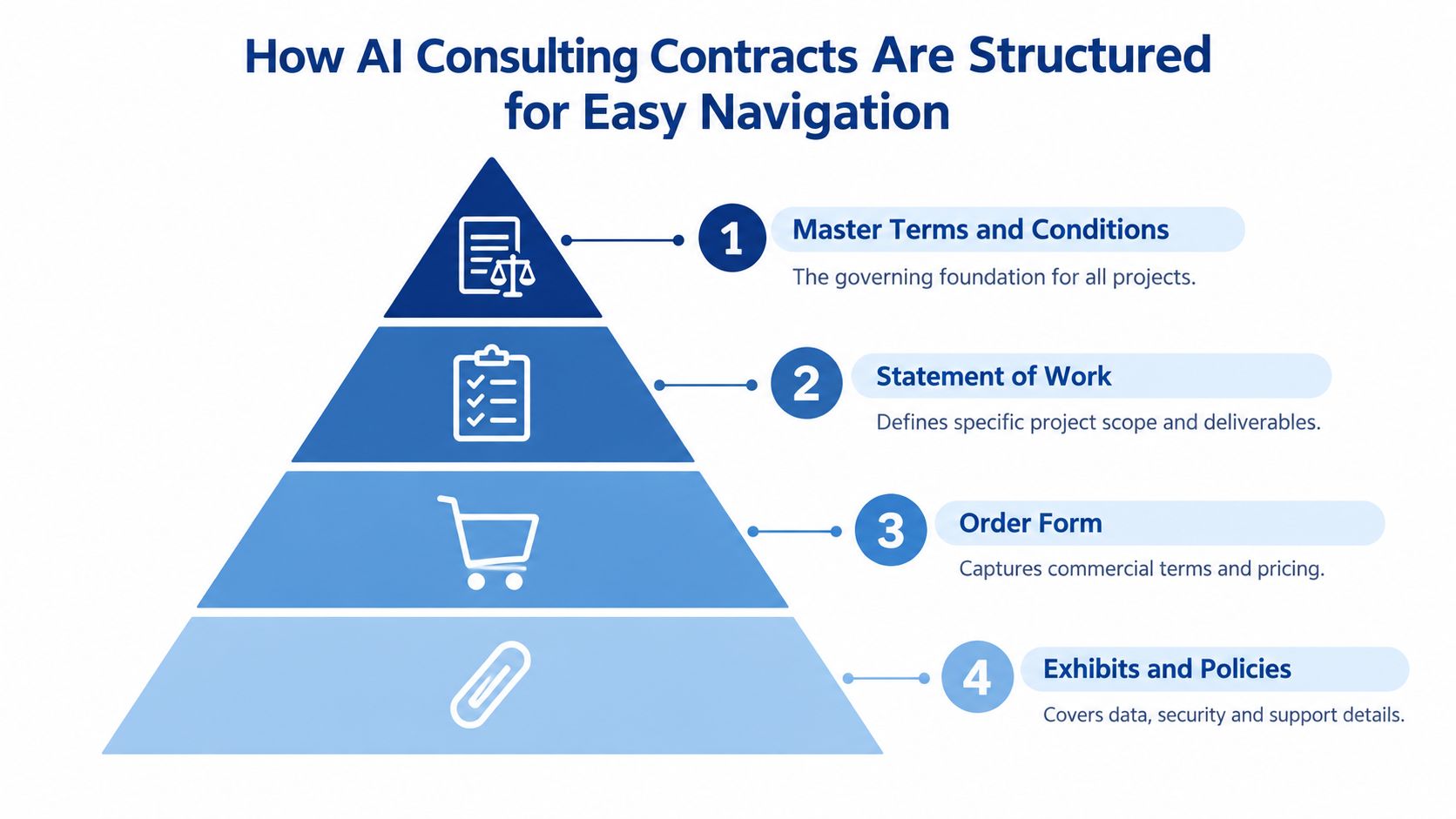
A useful contract pack connects four documents. The master agreement contains reusable legal and operational terms. The statement of work, or SOW, describes the specific project. The order form or proposal captures commercial terms. Exhibits handle supporting details such as security, data processing, support levels, or technical requirements.
Practical rule: If a request changes the workflow, deliverable, acceptance test, timeline, or effort, treat it as a scope decision, not as a casual Slack message.
A master agreement and an SOW solve different problems. The master agreement avoids renegotiating confidentiality, intellectual property, termination, and dispute provisions for every engagement. The SOW lets you define the exact automation without making the entire legal document client-specific. For a retainer with a setup fee, the SOW can cover the initial audit and build, while the order form describes the recurring service period and billing rhythm.
The contract-reading behavior data summarized by Goldberg Law Office shows why presentation matters. A Deloitte survey cited there found that 91% of U.S. consumers consented to legal terms without reading them, including 97% of adults aged 18–34, while another report found that only 16% of Americans read every word before signing. Those figures don't mean a consultant should hide important terms. They mean key provisions need clear headings, conspicuous presentation, and a reliable assent process.
Use this guide as a lookup reference. Start with the structure, then find the clause category that matches the delivery risk in front of you. The strongest agreement is the one you can quickly locate, explain, update, and apply during a live client engagement.
How AI Consulting Contracts Are Structured for Easy Navigation
A reusable AI consulting contract works best as a layered system. Each document has a narrow job, and every layer should identify which document controls if the wording conflicts.
The four contract layers
At the foundation sits the master terms and conditions. It should contain the provisions you expect to reuse, including definitions, confidentiality, intellectual property, payment mechanics, warranties, liability, termination, governing law, and dispute resolution. Keeping these terms stable reduces the risk that a rushed proposal accidentally omits a major protection.
The statement of work sits above the foundation. It should answer operational questions: What are you building? What systems are included? What does the client need to provide? How will acceptance work? What isn't included? The SOW is where an AI automation engagement becomes concrete.
The order form or proposal records the commercial deal. Put the setup fee, retainer, billing frequency, payment trigger, expenses, service period, and selected SOW in a place the buyer can review without searching through legal provisions. If the proposal contains promises about outcomes, align those promises with the acceptance criteria and warranty language.
Exhibits and policies hold specialized material. Examples include a data-processing schedule, security requirements, support response rules, approved software list, or model-use policy. These attachments let you add detail without turning every SOW into a technical and legal encyclopedia.
| Layer | Primary job | Typical contents |
|---|---|---|
| Master agreement | Governing relationship | Confidentiality, IP, payment rules, liability, termination |
| SOW | Defining delivery | Scope, exclusions, milestones, assumptions, acceptance |
| Order form | Recording the deal | Fees, term, billing, selected services |
| Exhibits | Adding detail | Data, security, support, technical policies |
Precedence and template hygiene
Add a precedence clause that states which document controls in a conflict. A common pattern is to make the SOW control over the master agreement only for project-specific scope and commercial details, while the master agreement continues to control legal protections. Your lawyer should tailor the hierarchy to the jurisdictions and clients you serve.
Version every document. Use a date, document name, client name, and version identifier. Don't edit an executed SOW in place. Issue a change request or amendment that identifies the original document and the exact replacement language.
Template hygiene matters just as much as drafting quality. Remove old client names, obsolete software references, incorrect currencies, abandoned support promises, and comments before sending. Maintain a clause library, but don't assemble agreements by copying random paragraphs from prior deals.
If you want a separate operating-process reference, SeanNoCode's business SOP course is one resource that addresses repeatable procedures alongside client delivery. The contract should reflect those procedures, especially around intake, approvals, handover, and change requests.
Essential Contract Clauses Every AI Consultant Should Define
Core clauses become useful when they answer a delivery question in plain language. If a provision can't help you decide what happens on a Tuesday afternoon, it probably needs a clearer operational connection.
Parties and definitions
Name the legal entities, not just the brand names or the individuals involved in the sales call. Define terms such as Services, Deliverables, Client Materials, Background Technology, Third-Party Services, Acceptance Criteria, and Change Request.
Definitions prevent arguments over whether a prompt library is a deliverable, whether a connected CRM is a third-party service, or whether a workflow template is your background technology. Keep definitions consistent across the master agreement, SOW, proposal, and exhibits.
Term and termination
The term says when the relationship begins and ends. Termination provisions should distinguish termination for convenience, termination for material breach, nonpayment, insolvency, or a serious security issue.
For an AI engagement, specify what happens after termination. The client may receive paid-for deliverables, but you may need time to export configuration, document the system, remove access, and delete or return client data. State whether outstanding fees become immediately due and whether a setup fee is refundable. Don't promise indefinite transition support unless you've priced it.
Services and deliverables
Describe what you will do and what the client will receive. “Build an AI assistant” is too broad. A stronger description identifies the workflow, interfaces, integrations, configuration, documentation, testing, and handover materials.
Tie services to the SOW. The master agreement can establish the general relationship, while each SOW identifies the actual deliverables. Cross-reference acceptance criteria and change control so a client can't interpret a general service description as an unlimited obligation.
Fees and payment schedule
State the amount, currency, invoice timing, payment due date, expenses, taxes, late-payment treatment, and suspension rights. For a setup fee plus retainer, separate the one-time build economics from recurring support. The setup fee funds discovery, architecture, implementation, and initial testing. The retainer should define the included service capacity or support category, not operate as a vague promise to handle anything.
Don't make payment depend entirely on subjective satisfaction. Use objective milestones or acceptance events, with a defined review period and a process for reporting nonconformity.
Expenses and client dependencies
Identify reimbursable expenses and require approval where appropriate. Document client dependencies. If the client must provide API access, sample data, subject-matter experts, credentials, or approval feedback, state what happens when those inputs arrive late.
A delay clause shouldn't be punitive. It should adjust the timeline and, where appropriate, reserve capacity or additional fees when the consultant must reschedule work.
Governing law and dispute resolution
Choose governing law and a dispute process that fit the client, project, and applicable mandatory rules. State notice requirements, escalation steps, venue, arbitration mechanics, and whether emergency relief is available.
The U.S. Bureau of Justice Statistics report on contract disputes estimated 366,000 civil contract disputes disposed of in state courts of general jurisdiction in the nation's 75 most populous counties during the year ending in June 1992. Businesses were plaintiffs in 68% of those cases, and fewer than 3% reached a jury or bench trial. The practical lesson is that written terms influence negotiation and settlement long before a final hearing.
Scope of Work Acceptance Criteria and Change Control in Practice
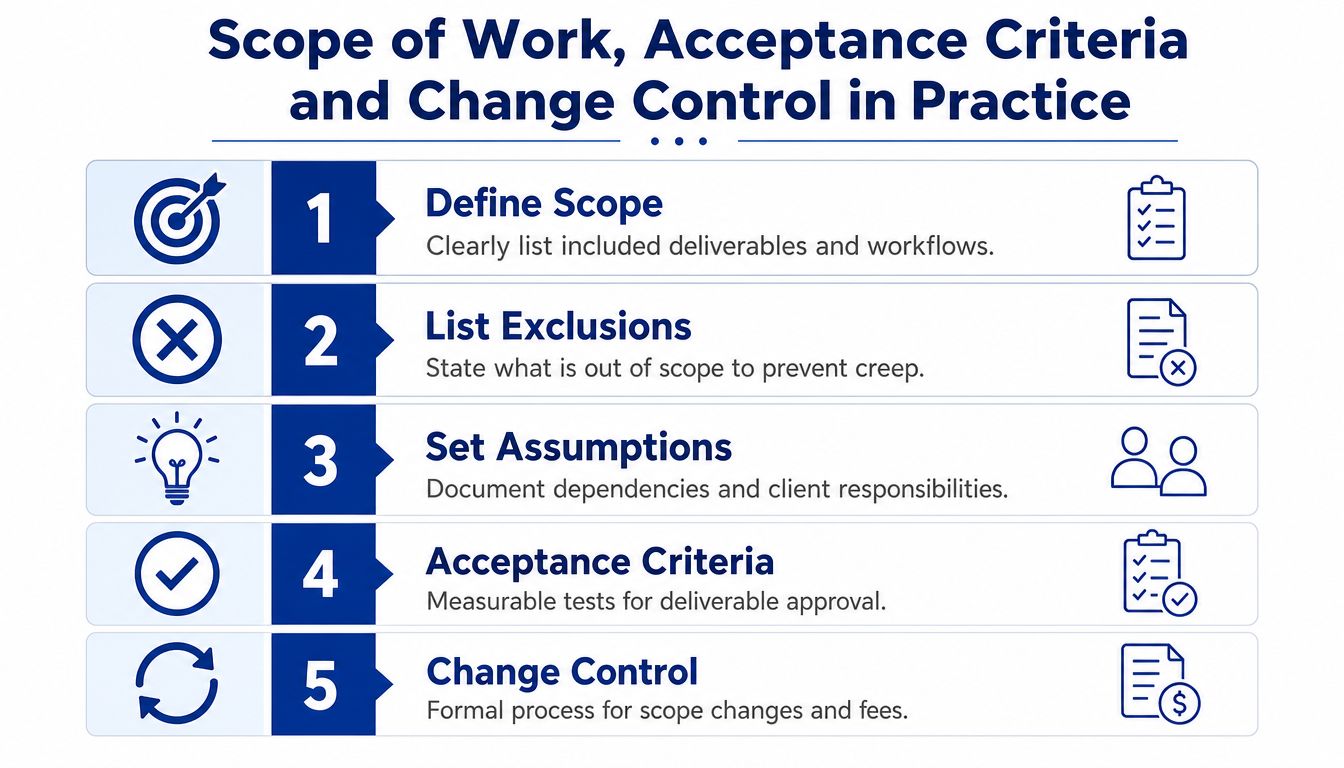
Scope control starts by separating the reusable legal relationship from the project-specific delivery plan. The master agreement should not carry the details of every automation. The SOW should.
A useful SOW gives the client enough detail to approve the work without forcing you to predict every future request. It should describe the current system, target workflow, deliverables, exclusions, assumptions, milestones, dependencies, acceptance tests, and change process.
Build the scope around boundaries
Use an in-scope and out-of-scope table. It forces both parties to discuss edges before implementation begins.
| In scope | Out of scope |
|---|---|
| Configure the agreed lead-routing workflow | Redesign the client's entire CRM |
| Connect the named data source | Import and clean every historical record |
| Create the agreed prompt and review flow | Guarantee unrestricted factual accuracy |
| Provide documented handover for the delivered workflow | Provide unlimited staff training |
| Complete the listed acceptance tests | Add new channels without approval |
The statement of work guidance from ZiaSign recommends separating the master agreement from the SOW and defining scope, exclusions, acceptance criteria, assumptions, and written change approval. That structure works because it converts a broad service promise into a controlled delivery surface.
Assumptions belong in the SOW, not in your head. Write down that the client will provide access, supply usable source material, appoint an approver, review deliverables within the agreed review window, and make decisions through a named channel. If the assumption changes, the timeline or price may need to change too.
Make acceptance testable
Acceptance criteria should describe observable behavior. For example:
- The workflow receives a test submission from the agreed form.
- It classifies the submission using the approved categories.
- It writes the result to the named CRM fields.
- It routes exceptions to the designated review queue.
- It produces the agreed notification.
- It records an auditable status for each test case.
Avoid criteria such as “works well,” “feels intelligent,” or “is production-ready” unless you define how the parties will evaluate them. AI outputs can vary, so specify the workflow behavior, review controls, permitted use, and escalation path rather than promising that every generated answer will be correct.
Give the client a clear acceptance procedure. The client reviews the deliverable against the listed criteria, identifies specific nonconformities, and allows you to correct them. If the client uses the deliverable in production or fails to report a specific issue within the agreed process, the SOW can address whether that constitutes acceptance, subject to applicable law and legal review.
Treat changes as commercial decisions
A change request should identify:
- Requested change: What the client wants added, removed, or altered.
- Reason: Why the change is needed.
- Scope impact: Which deliverable or acceptance test changes.
- Fee impact: Whether the work uses existing capacity or requires additional billing.
- Timeline impact: Whether milestones or handover dates move.
- Dependencies: What the client or a third party must provide.
- Approval: Which authorized person accepts the revised terms.
Don't start out-of-scope work because the request appeared in a friendly message. A written approval can be lightweight, but it must identify the decision. This protects a setup-fee project from absorbing a second build and protects a retainer from becoming an unlimited development bucket.
If the workflow has unclear inputs or inconsistent source data, an AI audit can be scoped as a separate diagnostic deliverable. That keeps discovery work visible instead of consuming implementation time.
The supporting walkthrough belongs later in the reader's process, after the scope tables and acceptance logic are clear.
Fees Payment Terms Warranties and Liability Limits Explained
Commercial terms determine whether the engagement can support the work promised. AI consultants often price the build, then leave support, revisions, monitoring, and third-party dependencies undefined. The result is a contract that states a price without stating what the price buys.
Match the payment model to the work
A fixed fee works when the scope and acceptance tests are stable. It gives the client budget certainty, but it puts delivery risk on you if assumptions are weak.
Time and materials works when discovery is genuine or requirements are likely to change. It protects against unknowns, but the client may worry about an open-ended bill unless you provide estimates, caps, or approval thresholds.
A retainer works for ongoing support, optimization, and a defined service cadence. It should identify what the retainer includes, what gets prioritized, how unused capacity is treated, and whether new builds require separate approval.
A retainer plus setup fee often fits AI automation work because implementation and ongoing service have different economics. The setup fee can cover discovery, architecture, configuration, testing, and handover. The retainer can then cover monitoring, agreed support, small improvements, and scheduled reviews. The SOW must still distinguish maintenance from new scope.
Use payment triggers that correspond to work events. An invoice might be tied to signing, commencement, a milestone, acceptance, or the start of a service period. Include a right to pause work for overdue invoices, but pair it with a notice process and a clear effect on delivery dates.
Connect warranties, disclaimers, indemnity, and caps
A warranty should describe what you can reasonably control. You may warrant that services will be performed with reasonable skill and care, or that deliverables will materially conform to the SOW during a defined correction period. Avoid promising business results that depend on client adoption, source data, third-party uptime, or model behavior.
AI-specific disclaimers should explain that generated outputs may require human review, can contain errors, and depend on input quality and third-party systems. The disclaimer shouldn't erase every obligation. It should sit beside clear implementation commitments, testing responsibilities, and client review duties.
Indemnity and limitation of liability need to work together. Indemnity may allocate specific third-party claims, while the liability cap limits broader exposure. If the contract doesn't say whether indemnity sits inside or outside the cap, the parties may fight about the very risk allocation they thought they had settled.
For low-risk, low-value services, public-sector guidance may accept standard commercial liability limits, but the contract should still identify the cap, carve-outs, and indemnity treatment. The Treasury Board of Canada guidance on liability and indemnity stresses that the cap should align with the risk profile and that the provisions should remain internally consistent.
Risk allocation should be designed, not copied. A cap that looks familiar may be unsuitable for sensitive data, regulated operations, consequential integrations, or a client demanding broad indemnity.
Review at least these questions:
- Does the cap apply to each claim, the whole agreement, or a defined period?
- Are confidentiality, data misuse, IP infringement, fraud, and willful misconduct treated separately?
- Does an indemnity create exposure beyond the cap?
- Do warranties have a correction remedy?
- Can the consultant suspend access or services after nonpayment?
Intellectual Property Data Use and Confidentiality for AI Deliverables
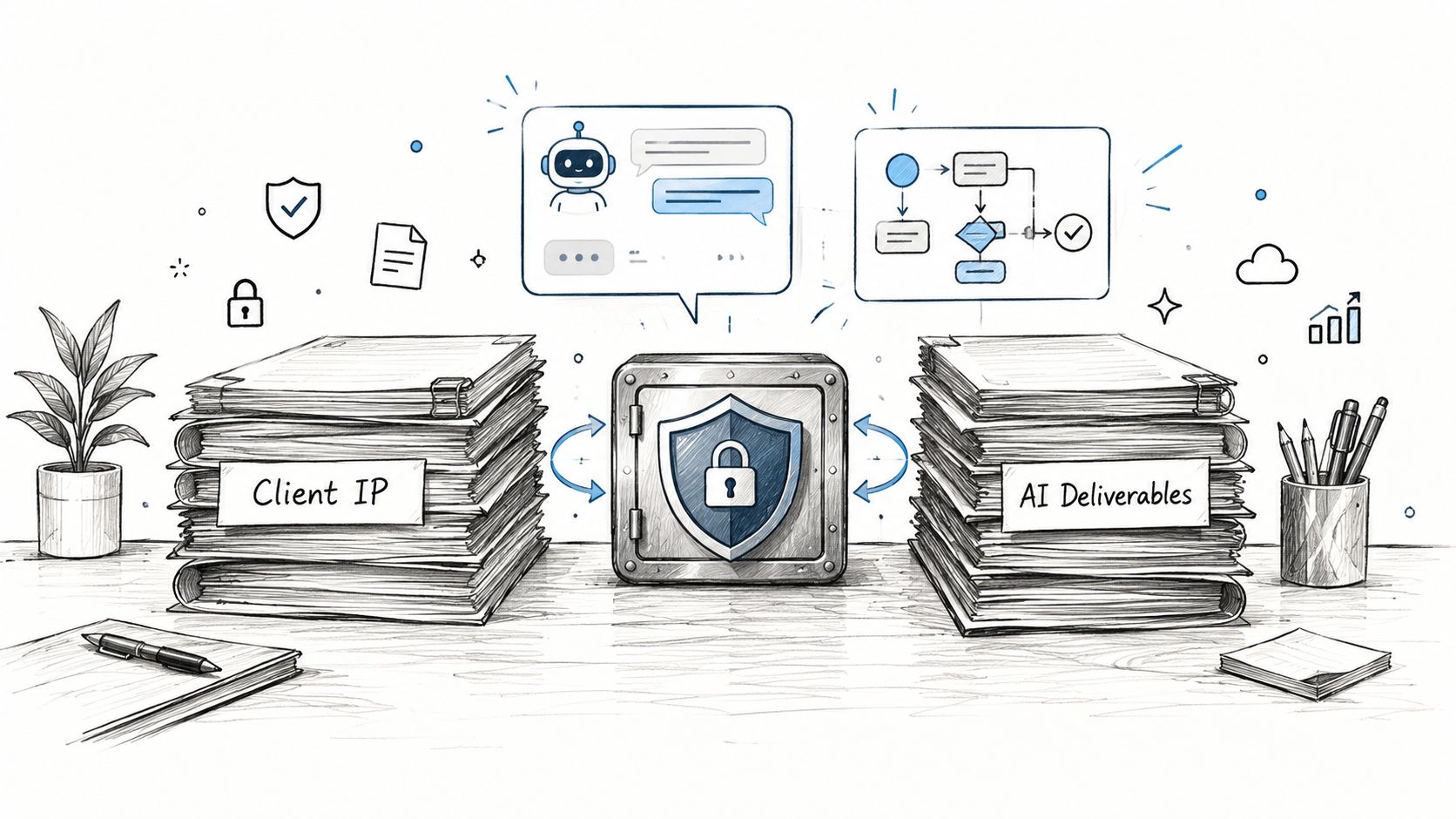
AI projects contain multiple kinds of assets, and ownership becomes confusing when the contract calls everything “the work.” A prompt library, automation framework, client-provided dataset, configured workflow, API account, model output, and handover document may require different treatment.
Separate the asset categories
Start with four buckets:
- Client materials: Data, brand assets, documents, credentials, workflows, and instructions the client supplies.
- Consultant background IP: Reusable templates, libraries, methods, connectors, prompts, internal tooling, and know-how developed before or outside the engagement.
- Project deliverables: The configured automation, documentation, custom interface, agreed prompt set, or other items expressly listed in the SOW.
- Third-party technology: Models, hosting, automation platforms, plugins, APIs, and software controlled by someone else.
A practical ownership clause can assign specified deliverable IP to the client after full payment while reserving your background IP. You then grant the client a license to the embedded background components as needed to use the deliverable. That model supports handover without giving away the reusable system that makes future delivery possible.
A license may be better than an assignment when you're providing access to a hosted workflow, proprietary framework, or ongoing service. Define its scope, duration, permitted users, modification rights, transfer rules, and termination effect. Don't promise ownership of third-party components that you can't assign.
Treat data use as an operating rule
State whether you may access client data, for which purposes, and through which approved systems. Address model inputs and outputs, human review, retention, deletion or return, subprocessors, security responsibilities, and incident notification. If a client prohibits training or secondary use of its data, put that restriction in the contract and align your actual tools and workflow with it.
Confidentiality should cover business information, source materials, credentials, prompts, system designs, and nonpublic outputs. It should also include practical exceptions for information that is already known, independently developed, publicly available without breach, or lawfully received from another source.
Offboarding is part of IP management. Specify what the client receives, which access is removed, how data is returned or deleted, and whether continued support is billed separately. Cross-reference termination, acceptance, warranties, and payment so ownership doesn't transfer before the commercial conditions are satisfied.
For consultants building production-ready agents and workflows, SeanNoCode's AI agents and workflows course is one available training resource. The agreement still needs to reflect the actual tools, data flows, and ownership promises in your engagement.
Enforceability Unfair Terms and When Statutes Override Your Clauses
A signed contract isn't automatically a winning argument. Enforceability depends on formation, notice, assent, clarity, applicable law, and whether mandatory rules restrict the clause.
Digital acceptance deserves special attention. If arbitration, automatic renewal, data use, or liability limits are buried in a long page, the business may struggle to show that the user received meaningful notice of the important term. Clear headings, accessible links, an unticked acceptance control, and records of the version presented create a stronger assent trail than a passive footer link.
Unfairness is a separate review
Clarity doesn't cure every problem. A term can be easy to read and still attract scrutiny if it creates a serious imbalance, imposes unexpected burdens, or attempts to remove protections that mandatory law preserves.
Australia's Treasury portfolio has described expanded unfair-contract-term enforcement for consumer and small-business contracts, with penalties increased to as much as A$100 million per offence under the measure discussed in the Treasury Minister's unfair-contract-term release. For consultants using one template across jurisdictions, that makes an unfair-terms review a business-control issue, not a formatting exercise.
Review standard terms for:
- One-sided discretion: Can only one party change scope, price, or renewal terms?
- Hidden renewal: Does the client receive clear notice of renewal and cancellation requirements?
- Overbroad exclusion: Does the clause attempt to disclaim responsibilities that cannot legally be disclaimed?
- Disproportionate remedy: Does a minor breach trigger a severe consequence?
- Unexpected burden: Would a reasonable client notice and understand the term before agreeing?
Statute can outrank the contract
The hierarchy is straightforward in principle:
- Mandatory statute or regulation applies first.
- Valid contract terms fill the space the law leaves open.
- Operational documents apply within the authority granted by the agreement.
- Informal messages should not rewrite signed terms.
MSME disputes show why this hierarchy matters. In India, statutory frameworks for MSME payment disputes can displace contractual arbitration and forum language, as discussed in Cyril Amarchand Mangaldas' analysis of MSME disputes. An exclusive-jurisdiction clause may carry different practical weight from a standalone arbitration clause in some disputes.
Before reusing a template, identify the client's location, business status, consumer or commercial role, data location, payment regime, and likely dispute forum. Then have qualified local counsel review mandatory protections, unfair-terms rules, privacy obligations, and dispute mechanisms. Contract drafting creates options. It doesn't let you contract out of every statute.
Quick Reference Lookup Tables Checklists and Related Resources
When a client problem appears, search by the operational symptom rather than by legal vocabulary. The right clause is usually the one connected to the failure mode.
Contract Clause Quick Finder for AI Engagements
| Situation | Check These Terms | What Good Wording Does |
|---|---|---|
| Scope creep | SOW, exclusions, change control | Defines what is included and requires written approval for additions |
| Late payment | Fees, invoice timing, suspension, termination | Sets the payment trigger and the consequences of nonpayment |
| Model hallucination | Acceptance, warranties, AI disclaimer, client review | Separates workflow performance from a promise of perfect output |
| Client delay | Assumptions, dependencies, milestones, schedule relief | Records client responsibilities and adjusts delivery when inputs arrive late |
| Ownership dispute | IP definitions, assignment, license, payment condition | Separates deliverables from background and third-party technology |
| Data concern | Confidentiality, data use, retention, security exhibit | Limits access and documents return, deletion, and permitted processing |
| Dispute escalation | Notice, negotiation, venue, arbitration, governing law | Creates a defined path while preserving mandatory statutory rights |
Pre-send contract checklist
Before sending an agreement, verify:
- Identity: The legal names, addresses, signatories, and authority are correct.
- Documents: The master agreement, SOW, order form, and exhibits use consistent names and dates.
- Scope: Deliverables, exclusions, assumptions, dependencies, and acceptance tests are specific.
- Commercials: Setup fee, retainer, billing dates, expenses, taxes, and suspension rights match the proposal.
- Changes: The change-request process identifies fee, schedule, deliverable, and approval effects.
- Ownership: Client materials, background IP, deliverables, and third-party tools are separated.
- AI use: Data access, model inputs, human review, retention, and output limitations are addressed.
- Risk: Warranty, indemnity, liability cap, carve-outs, and exclusions don't contradict one another.
- Exit: Termination, handover, access removal, data deletion, and unpaid balances are covered.
- Enforceability: Important terms are visible, assent is recorded, and mandatory local rules have been checked.
Keep a cross-reference index beside the template. Scope connects to acceptance and change control. Payment connects to suspension, termination, and IP transfer. Data connects to confidentiality, security, warranties, and offboarding. Dispute language connects to governing law and any mandatory statutory framework.
A consultant who ships repeatable automation work shouldn't rebuild these controls from memory for every client. SeanNoCode provides proposal, SOW, change-request, and contract-clause templates, along with delivery education and an AI audit framework for a $2–10K starter offer, as described in the publisher information. Use those materials as operational references, then obtain legal advice for your jurisdiction and risk profile.
Build your next AI engagement around a master agreement, a precise SOW, and a written change process before implementation starts. Visit SeanNoCode for practical resources on proposals, pricing, delivery workflows, and contract templates that connect client acquisition to controlled execution.