You're done with the build, the client's team has seen the demo, and the milestone invoice is sitting in your outbox. Then their operations lead replies that the workflow isn't what they pictured, because the SOW said “working solution” and “reasonable accuracy,” but nobody wrote down what done meant in a way both sides could test. That's how a clean delivery turns into two weeks of back-and-forth, and why a strong acceptance criteria format matters more in client work than in a sprint board.
Table of Contents
- The Invoice That Got Stuck Because Nobody Defined Done
- What Acceptance Criteria Actually Do in Client Work
- The Reusable Template Fields and How to Fill Them
- Choosing the Right Format for Your Deliverable
- Pass and Fail Tests With Real Data Samples
- Sign-Off Procedure Tied to Milestone Payment
- When Given-When-Then Is the Wrong Tool
- Acceptance Criteria as a Scope Creep Shield
- Copy-Paste Reference Block for Proposals and SOWs
- Quick Glossary of Terms Used in This Template
The Invoice That Got Stuck Because Nobody Defined Done
The worst part of a stalled invoice isn't the delay itself, it's that nobody feels obviously wrong. The consultant built the workflow the way the brief sounded in meetings, the client reviewed it against the picture in their head, and both sides used the same vague words to describe different outcomes. In paid delivery, that gap turns into a billing problem, not just a process annoyance.
A client-ready acceptance criteria format closes that gap before build starts. NIST's Guide to software acceptance formalized acceptance criteria as measurable acceptance requirements, saying buyers should “establish acceptance criteria for each measure for each product” and that those criteria should be “acceptable numeric values or ranges of values,” which is exactly the kind of specificity that keeps sign-off from drifting into opinion (NIST guide). NASA's software engineering handbook also treats acceptance criteria as conditions a system must satisfy before it's accepted, and places acceptance activity early in the Formulation phase, before implementation is finished (NASA acceptance criteria guidance).
For consultants and small agencies, the lesson is simple. If the criteria don't name the deliverable, the evidence, and the decision-maker, the milestone can't be defended in a review meeting. That's why the best SOW language isn't “the bot will work,” it's a short, testable block that tells the client what to inspect, what file proves it, and who signs off.
Two fields usually fix the whole mess, Expected Outcome and Evidence Required. In practice, those are the difference between a conversation and a contract.
What Acceptance Criteria Actually Do in Client Work
They turn scope into a testable agreement
In client services, acceptance criteria aren't a product-team ritual. They're the point where a verbal scope becomes a measurable obligation, and where the client's payment trigger can be tied to something the team can inspect without a meeting. That's why vague language costs real money, because it leaves the release decision open to interpretation.
A practical rule is to write each criterion so two people can review it independently and reach the same conclusion. NASA's guidance says acceptance criteria should be explicit enough for pass/fail evaluation, and the criteria should be measurable or observable, tied to a specific requirement, and written so the reviewer doesn't need to guess (NASA acceptance criteria). That makes the format useful for more than QA, it becomes the thing your client uses to decide whether the milestone is complete.
They define the proof, not just the promise
The second job is evidentiary. A good criterion names the artifact that proves the outcome happened, whether that's a screenshot, a CSV export, a log file, or a dashboard capture. Without evidence, a review meeting turns into “trust me,” and trust doesn't release payment.
Practical rule: if a criterion can't be proven with an artifact, it isn't ready for a client sign-off meeting.
They assign decision rights
The third job is ownership. Someone on the client side has to hold the pass/fail decision, and the SOW has to say who that is, how long they have to respond, and what happens if they don't. That keeps the approval path from getting stuck in a group chat where everyone assumes someone else will reply.
If you want a familiar reference point for how this plays in real delivery work, the internal blog at SeanNoCode uses the same basic discipline, pre-agreed conditions first, implementation second.
The Reusable Template Fields and How to Fill Them
A reusable acceptance criteria format works best when it behaves like a small appendix block, not a paragraph of prose. The goal is to make each field obvious enough that a client reviewer, a developer, and a project manager can all use the same page without translation.
Deliverable ID and description
Write the exact work item and keep it narrow. If the deliverable is a document-classification workflow, name that workflow, not the entire automation program.
Example: Deliverable ID, DC-01. Description, classify inbound invoice PDFs and route each document to the correct GL code.
Acceptance Owner
Write the named role that approves the milestone. Don't leave this as “client team.”
Example: Acceptance Owner, Operations Lead.
Preconditions
Write the system state and data state required before the test starts. If the automation needs access to a mailbox, CRM, or sample documents, say so.
Example: Preconditions, mailbox connected, GL code mapping table loaded, invoice sample set uploaded.
Trigger
Write the action that starts the test. Keep it observable.
Example: Trigger, a new invoice PDF arrives in the intake folder.
Expected Outcome
Write the specific result the reviewer should see. One outcome per criterion keeps the sign-off clean.
Example: Expected Outcome, the invoice is classified and routed to the matching GL code without manual intervention.
Evidence Required
Write the artifact and where it lives. If the reviewer can't find the proof, the criterion fails in practice even if the workflow worked.
Example: Evidence Required, routing log CSV stored in the shared QA folder, plus a screenshot of the final CRM record.
Threshold
Write the numeric cutoff that separates pass from fail. You anchor performance, accuracy, or latency.
Example: Threshold, correct routing on all tested samples.
Pass/Fail Rule
Write the decision logic as a binary statement. Avoid “mostly” and “generally.”
Example: Pass if all required fields are populated and the routing destination matches the approved GL code.
Sign-Off Method
Write how the reviewer records approval.
Example: Sign-Off Method, approval in the shared project form by email confirmation.
Linked Milestone
Write the billing trigger right in the block so the payment link can't be missed.
Example: Linked Milestone, milestone invoice 2 is released after acceptance.
Choosing the Right Format for Your Deliverable
A lead-routing workflow can be written three ways, and the right format depends on who has to approve it. A UX flow with one clear path fits a scenario. A data pipeline with variable inputs usually needs a checklist. A compliance-heavy workflow often works better as a rule-oriented hybrid.
| Format | Best For | Example Wording for High-Intent Inbound Lead | Reviewer Question It Answers |
|---|---|---|---|
| Given/When/Then | Deterministic user flows, integrations, and multi-step actions | Given a returning lead submits a demo request, when the system scores the lead, then it assigns the lead to the sales rep queue | Did the sequence produce the expected outcome? |
| Rule-based checklist | Automations, data pipelines, and scoring logic with variable inputs | High-intent lead score meets the routing threshold, assigned rep is filled, CRM record includes source fields, fallback queue is not used | Did every required rule pass? |
| Rule-oriented scenario | Conditional branching, compliance rules, and cases where context matters | Returning contact with high intent and matching territory routes to the assigned rep unless territory data is missing, in which case it goes to fallback review | Did the system follow the correct rule under this context? |
Match the format to the project type
Given/When/Then works when the client can describe the interaction as a clear sequence. Atlassian frames acceptance criteria as the confirmation part of the 3 Cs and shows how scenario-based criteria fit user-story style delivery (Atlassian user stories). A checklist is safer when the deliverable needs quick review and the inputs vary. A rule-oriented scenario sits in the middle, which is often where client automation work ends up.
The choice is less about taste and more about how the sign-off meeting will run. If the client needs to check a dozen conditions in one sitting, a checklist is easier to defend. If the client is approving a visible user action, scenario format reads more naturally. For consultants and small agencies, that difference affects more than readability, because vague criteria turn into billing disputes when a client says the work was not done “as expected.”
Pass and Fail Tests With Real Data Samples
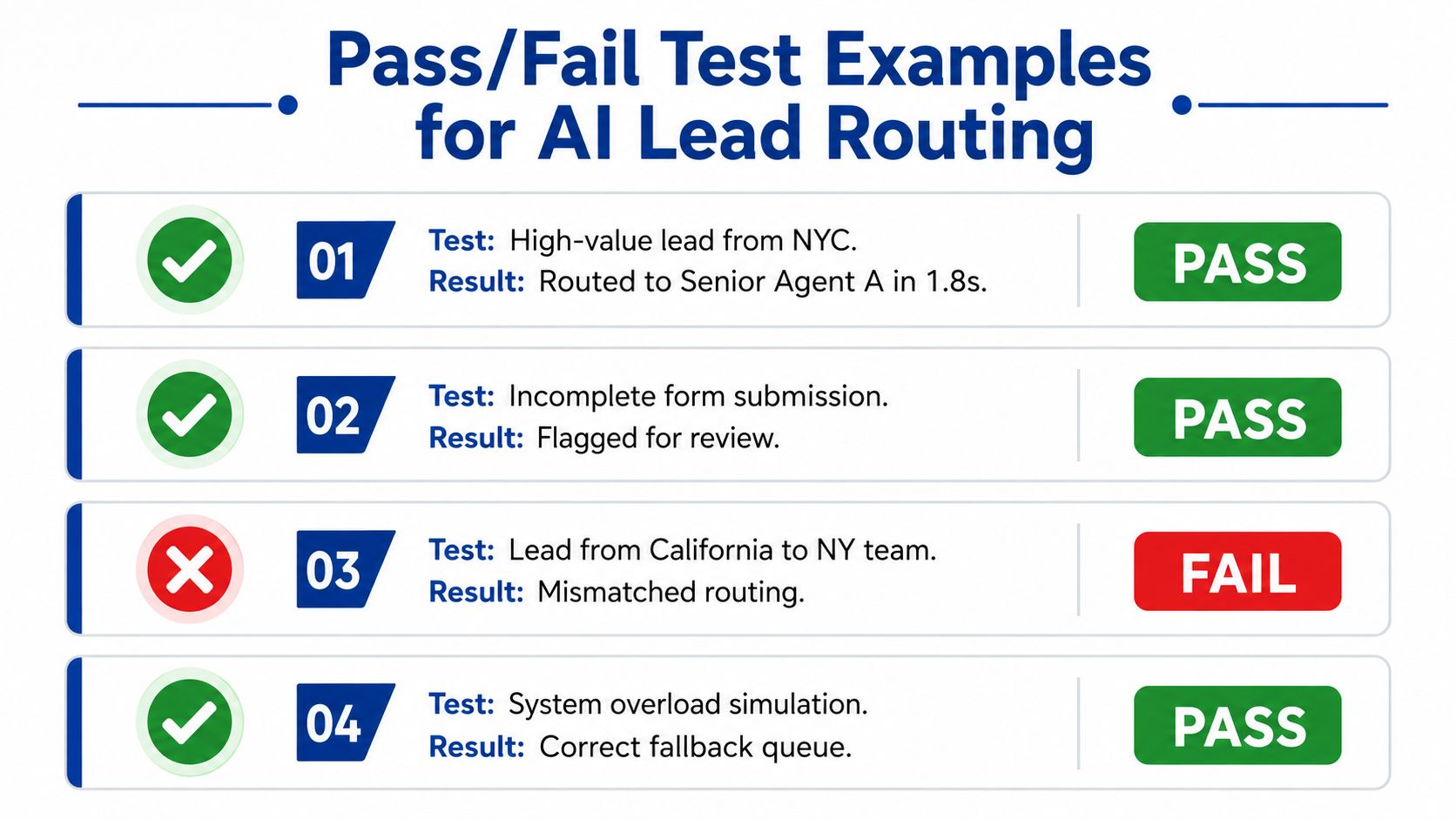
The strongest criteria are the ones a reviewer can mark without debate. For AI and automation work, that usually means a known good case, a known bad case, an edge case, and one performance test that measures the system under load.
Test case structure that holds up
Write the failure case first. It forces you to define the boundary before you celebrate the happy path. Then add the evidence artifact and the decision rule.
- Test 1, known good inbound lead: Precondition, lead score table loaded and CRM connection active. Input sample,
{"name":"Ava Chen","email":"ava@example.com","company":"Northwind","source":"demo_request","score":92,"territory":"NYC"}. Expected output, the lead routes to the assigned rep and appears in the CRM with all source fields populated. Evidence required, CRM screenshot and routing log in the QA folder. Pass if the lead is assigned within the review window and all fields match the source record. - Test 2, known spam lead: Precondition, spam detection rules enabled. Input sample, a lead with disposable email and missing company name. Expected output, the record is tagged with the exact string
spam_reviewand excluded from rep assignment. Evidence required, filter log and CRM tag screenshot. Pass if the tag is present and no rep is assigned. - Test 3, ambiguous lead: Precondition, fallback queue configured. Input sample, a high-intent lead with missing company size. Expected output, the record routes to the fallback queue without error. Evidence required, exception log and queue screenshot. Pass if the system does not fail and the fallback route is visible.
- Test 4, latency batch: Precondition, a batch of 100 leads is available. Measurement method, record processing time from ingestion to routing completion and review the 95th percentile across the batch. Expected output, processing stays under the approved threshold. Evidence required, batch report and timestamped logs. Pass if the measured result stays within the agreed limit.
Recent guidance has also pushed acceptance criteria toward more structured, machine-checkable formats for AI and automation projects, especially where non-functional behavior like performance or edge cases matters (6Sigma acceptance criteria discussion). That's a useful reminder that a “works on my machine” demo doesn't count as evidence.
Sign-Off Procedure Tied to Milestone Payment
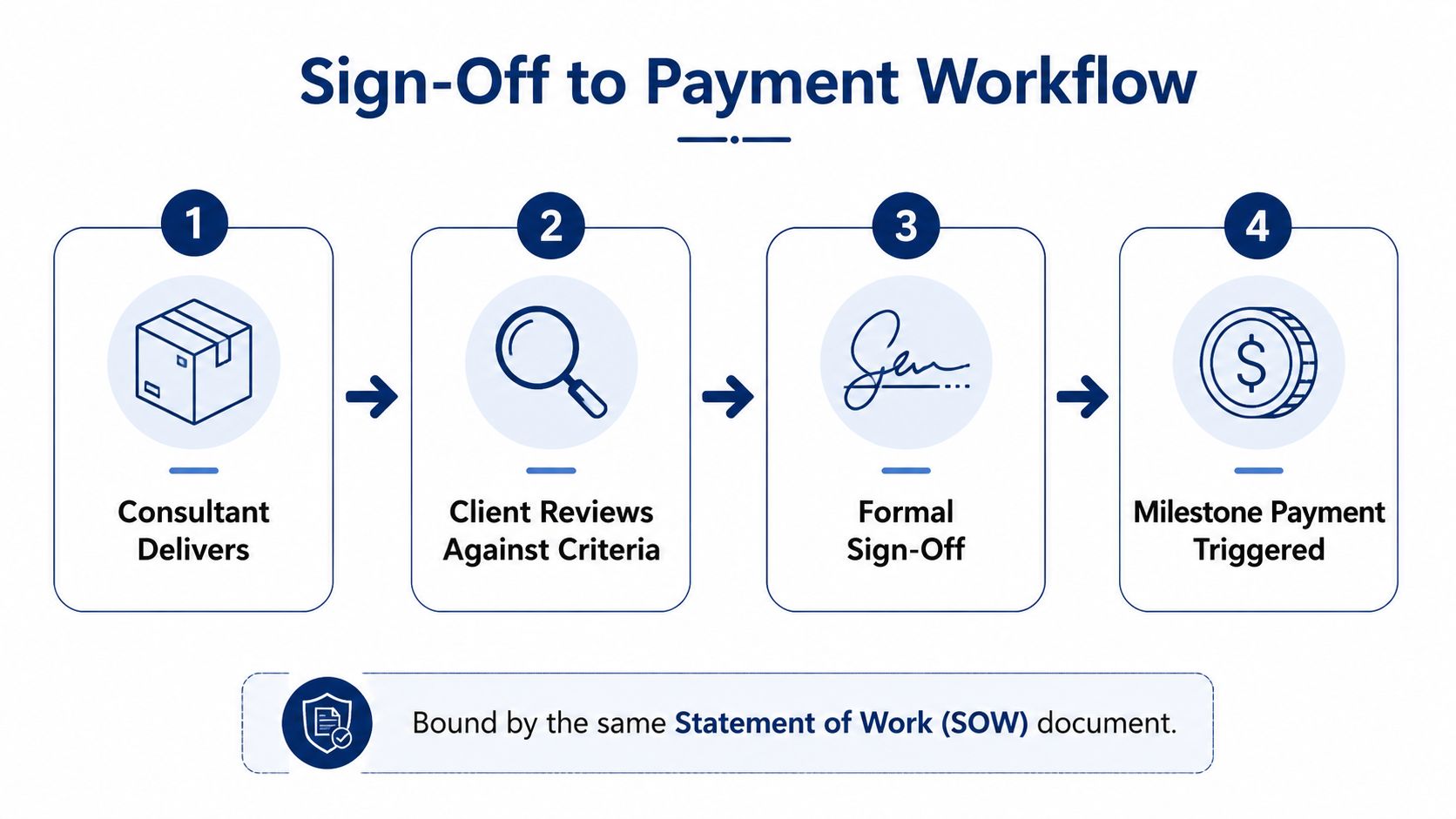
The review workflow should live in the same SOW as the criteria, not in a side email thread. If the acceptance block and the milestone invoice are tied together, the client knows exactly what they're approving and when payment releases.
SeanNoCode course materials cover the broader habit of documenting SOPs and handoffs, and this sign-off flow sits in the same lane.
A clean review sequence
- Consultant delivers evidence. Send the test logs, sample outputs, and screenshots to the named reviewer within the agreed window.
- Client reviews against criteria. The reviewer marks each item pass or fail using the same block that sits in the SOW.
- Formal sign-off happens in writing. Approval should be recorded by email or form, not by a casual verbal okay.
- Milestone payment triggers after sign-off. The invoice becomes payable only after the approved criteria are met.
Silence should never count as approval unless the contract says so. If the client hasn't responded inside the review window, the milestone is still pending, not magically complete.
Copy-ready SOW language
Use language like this in the agreement, adapted to your project:
Milestone payment for Deliverable DC-01 is due only after the Acceptance Owner confirms in writing that all listed acceptance criteria have passed. If any criterion fails, the consultant will remediate the issue and resubmit evidence for retest. Partial acceptance applies only when the SOW explicitly states it.
That wording keeps the sign-off process mechanical. It also stops a late-stage debate from becoming a payment dispute.
When Given-When-Then Is the Wrong Tool
Given/When/Then reads cleanly, but it isn't always the safest format for AI and automation delivery. When outputs vary from run to run, narrative scenarios can hide the core question inside a nice-looking sentence, and the client ends up arguing over interpretation instead of inspecting the result.
The failure mode is usually the same. The “Then” clause says something soft like “the system should route correctly,” but nobody can tell whether correctly means fastest, most likely, or legally acceptable. That's why rule-based checklists are often better for probabilistic systems, compliance-heavy outputs, and review meetings where the QA person has to score the deliverable quickly.
Use the simplest test that answers the question
- Use Given/When/Then for deterministic user flows with one right answer.
- Use a checklist when the output is probabilistic, the reviewer needs to score fast, or the work depends on threshold logic.
- Use a rule-oriented scenario when context changes the decision, especially in conditional branching or regulated workflows.
If the output needs a measurable ceiling, like a latency limit or a schema match requirement, a checklist is usually safer because the pass/fail logic sits in the open. That matters in AI work, where “feels accurate” is not a criterion anyone can defend in a client review meeting.
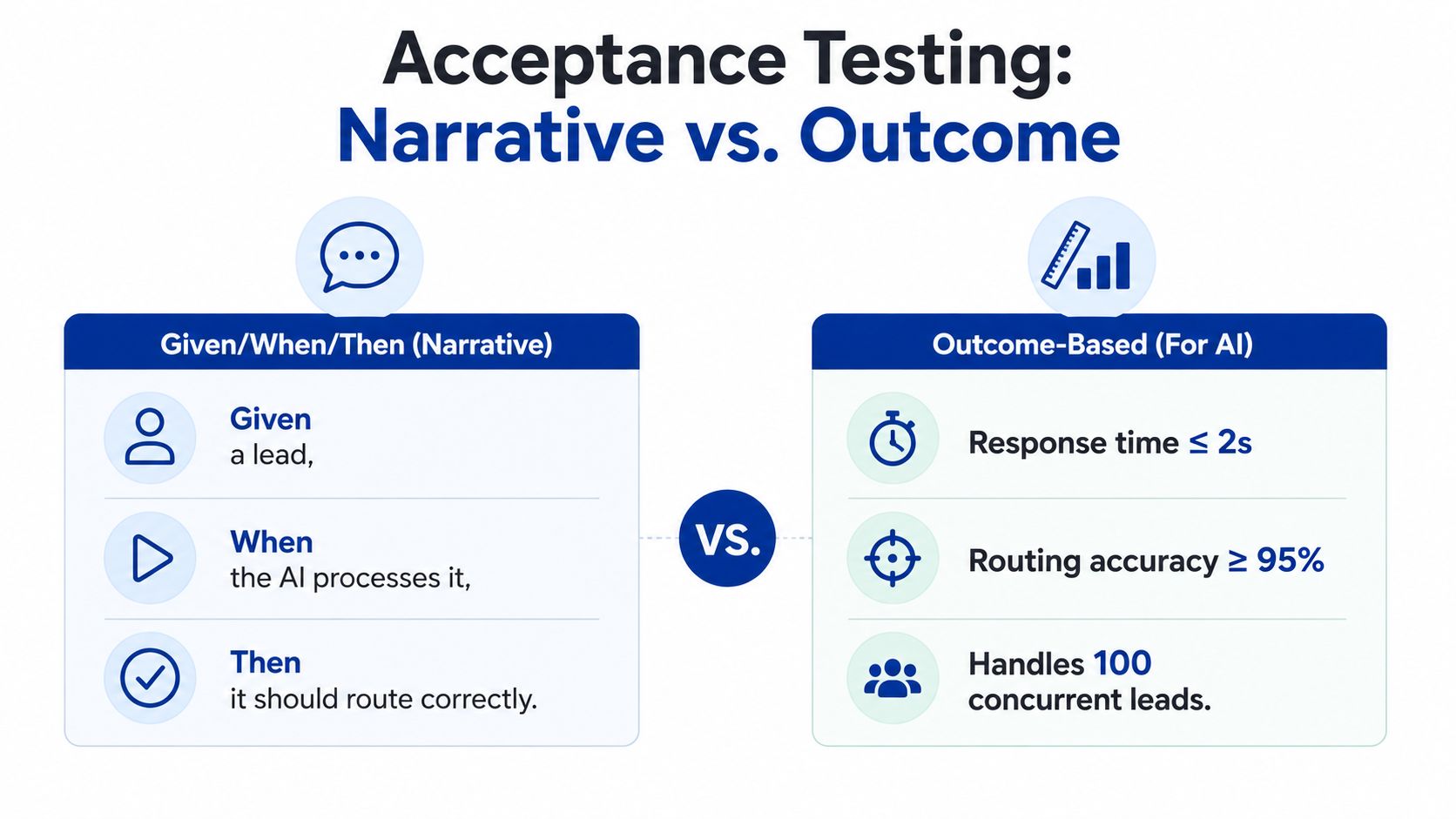
The comparison in the table above is the practical filter. If the reviewer needs to argue about grammar, the format is wrong. If the reviewer can mark pass or fail in under five minutes, you're probably in the right neighborhood.
Acceptance Criteria as a Scope Creep Shield
The best scope control happens before the client asks for the extra thing. A tight acceptance criteria format gives you a clean way to say, “That wasn't included,” without sounding defensive, because the contract already shows what was priced.
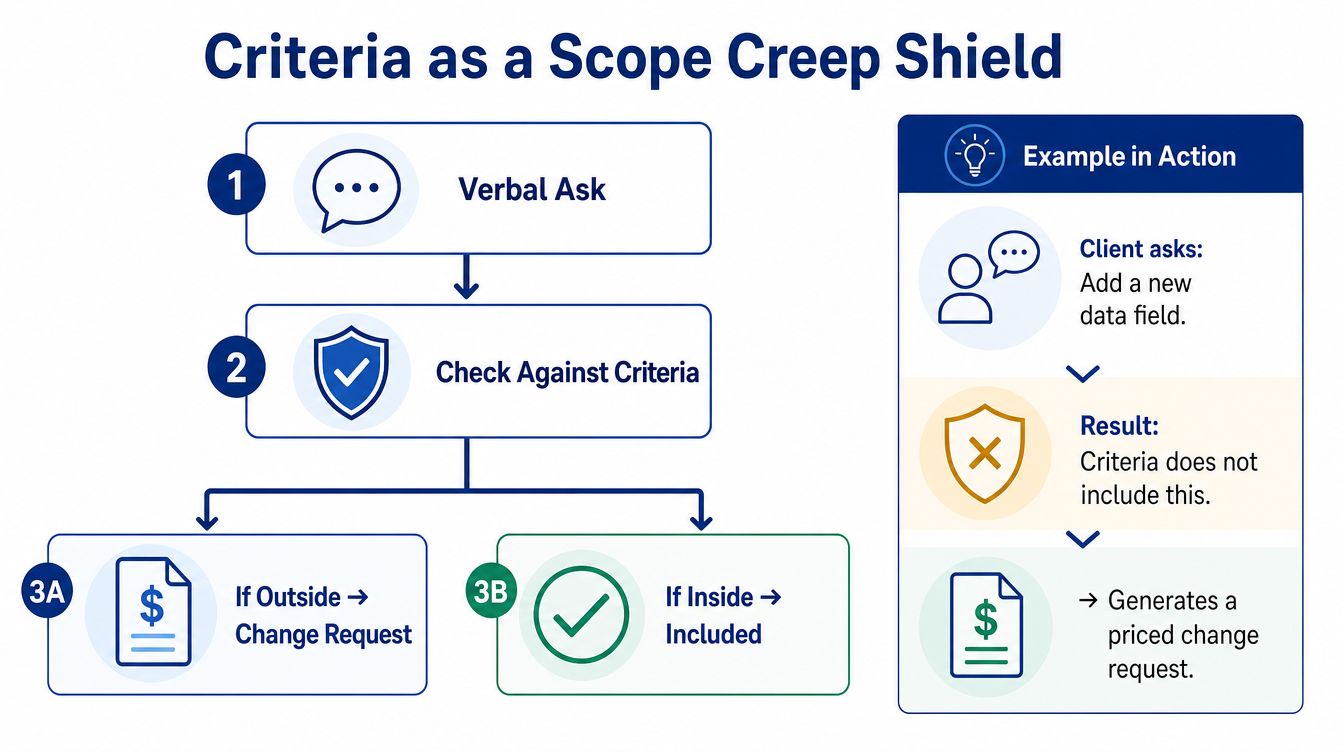
A common pattern goes like this. The client emails, “Can the bot also summarize PDFs?” You check the SOW, and the deliverable only covers structured data extraction. The request becomes a change order, not a silent revision, because Out of Scope and Change Trigger were written upfront.
The fields that do the protective work
- Deliverable Scope keeps the promise narrow.
- Out of Scope prevents hidden extras.
- Threshold defines when a partial change is still the same job.
- Change Trigger tells both sides when new work becomes billable.
If a non-English file type appears mid-build and the original criteria only listed English source documents, that's not a surprise requirement, it's a scoped exception. The consultant can price the change, and the client can approve it with eyes open.
The point isn't to say no more often. It's to make every new ask visible enough to price correctly.
That's the cleanest way to protect both sides. Clients get the work they paid for, and consultants don't end up donating engineering hours because the criteria were too soft to enforce.
Copy-Paste Reference Block for Proposals and SOWs
Use this block for any paid deliverable with a defined milestone. It keeps the proposal, the sign-off, and the invoice tied to the same artifact, which is the core job of the acceptance criteria format.
The broader sales and proposal materials at SeanNoCode sales training are a useful companion when the criteria have to support the sale and the delivery at the same time. For a client review meeting, that matters. Vague wording turns into debate, and debate turns into delayed approval or a change request.
| Field | Instruction | Example for AI Email Triage Workflow |
|---|---|---|
| Deliverable ID | Name the work item clearly | ET-01, classify inbound support emails |
| Scope | State what is included | Read incoming emails, tag intent, route to the right queue |
| Out of Scope | State what is not included | No reply drafting, no multilingual classification |
| Preconditions | List required system state | Mailbox connected, labels configured, test inbox populated |
| Trigger | Name the event that starts the test | A new email arrives in the shared inbox |
| Expected Outcome | State the observable result | Email is tagged and routed to the correct queue |
| Evidence | Name the proof artifact | Routing log, inbox screenshot, QA CSV |
| Threshold | Set the cutoff for pass | Correct routing on all approved test emails |
| Pass/Fail Test | State the binary rule | Pass if the email lands in the approved queue and required metadata is present |
| Reviewer | Name the approver | Client operations manager |
| Sign-off Date | Record when approval happens | Date entered in the project form |
| Change Trigger | Say when scope becomes billable | New language, new email source, or new queue rule |
Filled-in row: ET-01, route inbound support emails to the correct queue, evidence stored in the shared QA folder, pass only when the approved reviewer confirms the result in writing, milestone payment released after sign-off.
Quick Glossary of Terms Used in This Template
| Term | Definition | Example |
|---|---|---|
| Expected Outcome | The observable result that signals success | The invoice PDF is routed to the correct GL code |
| Evidence | The artifact that proves the result happened | CSV export, screenshot, or log file |
| Precondition | The starting state required before testing | CRM connected and sample data loaded |
| Threshold | The numeric boundary that separates pass from fail | 95% of invoice PDFs parse correctly within the approved time window |
| Trigger | The event that starts the test | A new file lands in the intake folder |
If you want help turning your own delivery scope into client-ready sign-off language, SeanNoCode can give you the proposal structure, scope wording, and change-control habits that keep AI automation projects billable. Visit SeanNoCode and use the templates to build a criteria block your client can approve without a second meeting.