Most advice about building an AI automation agency starts with the wrong question. It asks which tools to use, which chatbot to demo, or how to price a workshop, when the business is simpler and harder: ship systems that keep working after the sales call ends.
That matters because AI is already moving into normal operations, not side experiments. McKinsey reported that 65% of respondents were regularly using generative AI in at least one business function in early 2024, up from about one-third the year before, and 72% were using it in one or more functions overall. Bain later found that 87% of global companies had already deployed or were piloting generative AI, which means the buyer is no longer asking whether AI is interesting. They're asking who can make it reliable, repeatable, and worth the maintenance.
Table of Contents
- What an AI Automation Agency Actually Sells in 2026
- Team Structure for a Lean AI Automation Agency
- Pricing Models That Protect Margin and Fund Discovery
- Productized Offers Versus Custom Builds
- Standardizing Delivery From Scope to Handoff
- A Worked Example From First Audit to Retainer
- Your 90-Day Plan to Launch or Relaunch the Agency
What an AI Automation Agency Actually Sells in 2026
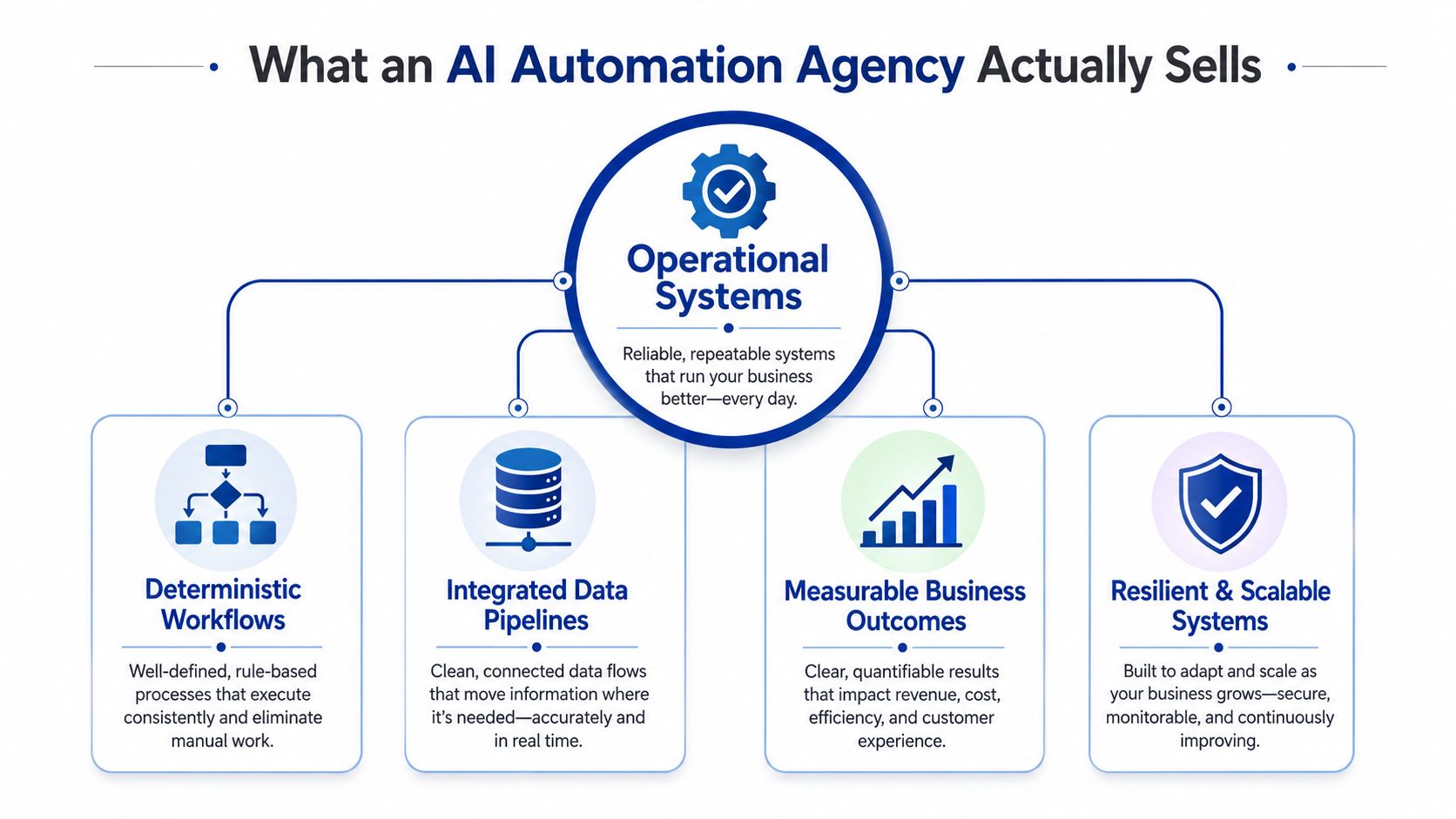
An AI automation agency doesn't sell a demo with a nice UI and a clever prompt. It sells an operational system that moves data, makes a decision, triggers the next step, and hands the result back to a human or another system without breaking the client's process.
That distinction matters because founders who start with a Zapier demo or a GPT wrapper usually get trapped in low-value work. Those offers are easy to copy, hard to defend on price, and even harder to support when the client asks, “Who owns this when the API changes?” In practice, the buyer wants the boring part done well, a workflow with clear inputs, predictable exceptions, and a path for handoff to ops.
The real unit of value
The unit of value is not the tool stack. It's the bounded process. That can be lead routing, intake, document classification, ticket triage, or a CRM update chain, but it has to be narrow enough to define, test, and accept.
Practical rule: if you can't write the workflow in plain English on one page, you're not ready to sell it.
That's why the best agencies talk about hours reclaimed, fewer manual handoffs, cleaner records, or faster reviews rather than “AI transformation.” The verified delivery benchmarks back that framing, public field evidence shows roughly 15% to 56% task productivity gains, about 1.9 to 4.0 hours saved per worker per week in Copilot-style deployments, and 20% to 40% reductions in review turnaround time when baseline measurement is done correctly (AI automation ROI benchmark). Those are the kinds of outcomes you can scope, test, and hand over.
The agencies that win are the ones that can say, “Here's the workflow, here's the exception path, here's what acceptance looks like, and here's who owns it after launch.” That positioning is much stronger than selling novelty, because operational systems are what clients keep paying to maintain.
Team Structure for a Lean AI Automation Agency
A lean agency doesn't need a big bench to start. It needs clear ownership, because the fastest way to kill margin is to let the founder become the project manager, prompt writer, QA reviewer, and client firefighter at the same time.
The minimum viable team
The first version is straightforward. The founder sells, scopes, and handles the client relationship. A senior builder ships the automations, handles integrations, and writes the implementation notes. If client work starts to stack up, a fractional delivery lead runs calls, keeps scope tight, and pushes the project through acceptance.
That setup keeps midnight work from becoming the business model. It also gives each role a real job instead of a vague title. The founder owns deal qualification and pricing, the builder owns production, and the delivery lead owns cadence, change requests, and handoff.
| Stage | Client Count | Core Roles | First Next Hire |
|---|---|---|---|
| Solo with subcontractor bench | 0 to 3 | Founder, freelance builder, part-time QA | Fractional delivery lead |
| Small core team | 4 to 8 | Founder, senior builder, delivery lead, subcontractor support | Operations coordinator or second builder |
| Small squad | 8+ | Founder, builder, delivery lead, account manager, specialist bench | Dedicated account manager |
The internal operating rule is simple. Hire the role that removes the biggest bottleneck, not the role that sounds impressive in a hiring post. If the founder is still writing scopes, don't hire sales. If delivery slips because no one is controlling calls and approvals, don't hire another builder yet.
For founders still learning the mechanics, this course on AI agent workflows is one useful reference point for how to structure production work without turning every client into a custom science project.
When to convert subcontractors
Use subcontractors until the same tasks show up repeatedly. The moment a contractor is doing the same build pattern, the same debugging, or the same client communication every week, that's usually the conversion point to full-time.
Don't hire for hope. Hire when the system already exists and the workload is boring in the right way.
The main mistake is bringing in a sales rep before the delivery system is standardized. That almost always raises lead flow faster than fulfillment can absorb it, which means the founder ends up discounting, renegotiating, or eating support hours. A small agency protects margin by standardizing delivery before it scales demand.
Pricing Models That Protect Margin and Fund Discovery
Pricing is where most new agencies leak profit. They quote too early, underprice discovery, and then discover that the hard part wasn't the workflow build, it was the ambiguity around inputs, ownership, and client responsiveness.
Three models and where they break
Pure project pricing is the cleanest on paper. The agency quotes one fixed number, the client expects one fixed result, and every change creates tension unless the scope was documented extremely well. It works for tightly bounded work, but it's fragile when the client's process is still shifting.
Pure retainer pricing sounds stable, but it often hides underuse. The client expects ongoing support, the agency needs enough actual work to justify the fee, and idle time turns into margin drag if the retainer was set too high or too low.
Hybrid setup-fee-plus-retainer usually wins for small agencies because it funds real discovery upfront and keeps the long tail monetized. The setup fee pays for scoping, acceptance criteria, and the first build. The retainer covers monitoring, edge cases, small improvements, and the reality that automations need care after launch.
| Model | What Is Quoted | Margin Risk | Best Fit |
|---|---|---|---|
| Pure project | One fixed delivery fee | Scope creep and unpaid revisions | Narrow, clearly defined workflows |
| Pure retainer | Monthly support fee | Idle hours or vague deliverables | Mature systems with steady maintenance |
| Hybrid setup-fee-plus-retainer | Setup fee plus ongoing service fee | Lower, if scope and change control are written well | Most small AI automation agencies |
The practical pricing move is to separate discovery from ongoing operation. A setup fee should cover mapping, process review, and build. The retainer should cover monitoring, iterative improvements, and response time commitments. If change requests are common, publish the rate or define the fixed add-on before work starts.
The market is already leaning toward this structure. Independent pricing guides show that hybrid models are becoming the default because pure project pricing is vulnerable to scope creep and pure retainer pricing can underutilize effort (state of AI automation agencies). That lines up with how most agency owners work when they're protecting margin rather than selling fantasy.
A good contract also defines out-of-scope triggers. If the client wants a new data source, a new approval layer, or a second workflow family, it's a new change order, not “just a quick tweak.” That one sentence prevents a lot of free labor.
Productized Offers Versus Custom Builds
Custom work sounds premium, but in the first year it often just means uncontrolled complexity. Every new client becomes a new process design exercise, every edge case becomes a fresh debate, and every proposal starts from zero.
A productized stack gives you control
A lean agency should usually ship a productized stack with three layers. An AI audit creates the lead and surfaces the opportunity. A fixed-scope workflow build turns the opportunity into a concrete implementation. An agent retainer keeps the system healthy and expands it in a controlled way.
The audit is the easiest entry point to standardize because it's mostly analysis and prioritization. The fixed build is the trust builder because it proves the agency can ship something real. The retainer is the margin engine because it turns one-off delivery into recurring work.
That stack fits the economics better than pure custom engagements. Custom work can absolutely be profitable, but it tends to punish small teams with long sales cycles, vague deliverables, and repeated revision loops. A pure productized shop has the opposite problem, it caps deal size and leaves higher-value buyers under-served.
| Dimension | AI Audit | Fixed-Scope Workflow Build | Agent Retainer | Fully Custom Engagement |
|---|---|---|---|---|
| Buyer intent | Explore | Solve one process | Maintain and improve | Solve a unique, broad problem |
| Typical fit | New lead, uncertain scope | Confirmed use case | Live automation in production | Complex client with unusual constraints |
| Delivery control | High | High | Medium | Low |
| Margin risk | Low if scoped tightly | Medium if revisions aren't controlled | Medium if support is underspecified | High |
The practical pricing bands many small agencies use are easy to remember. Audits often sit in the $2,500 to $7,500 range, fixed builds in the $10,000 to $25,000 range, and retainers in the $3,000 to $8,000 monthly range. Those numbers are not magic, they're just a useful way to keep offers tied to scope instead of to wishful thinking.
Founder note: one productized offer is enough to standardize the first sale. The second offer should exist to turn that first sale into a repeatable delivery system.
Custom work still has a place when the buyer needs it. But for most small agencies, standardizing one audit, one build, and one retainer is what makes the business repeatable instead of exhausting.
Standardizing Delivery From Scope to Handoff
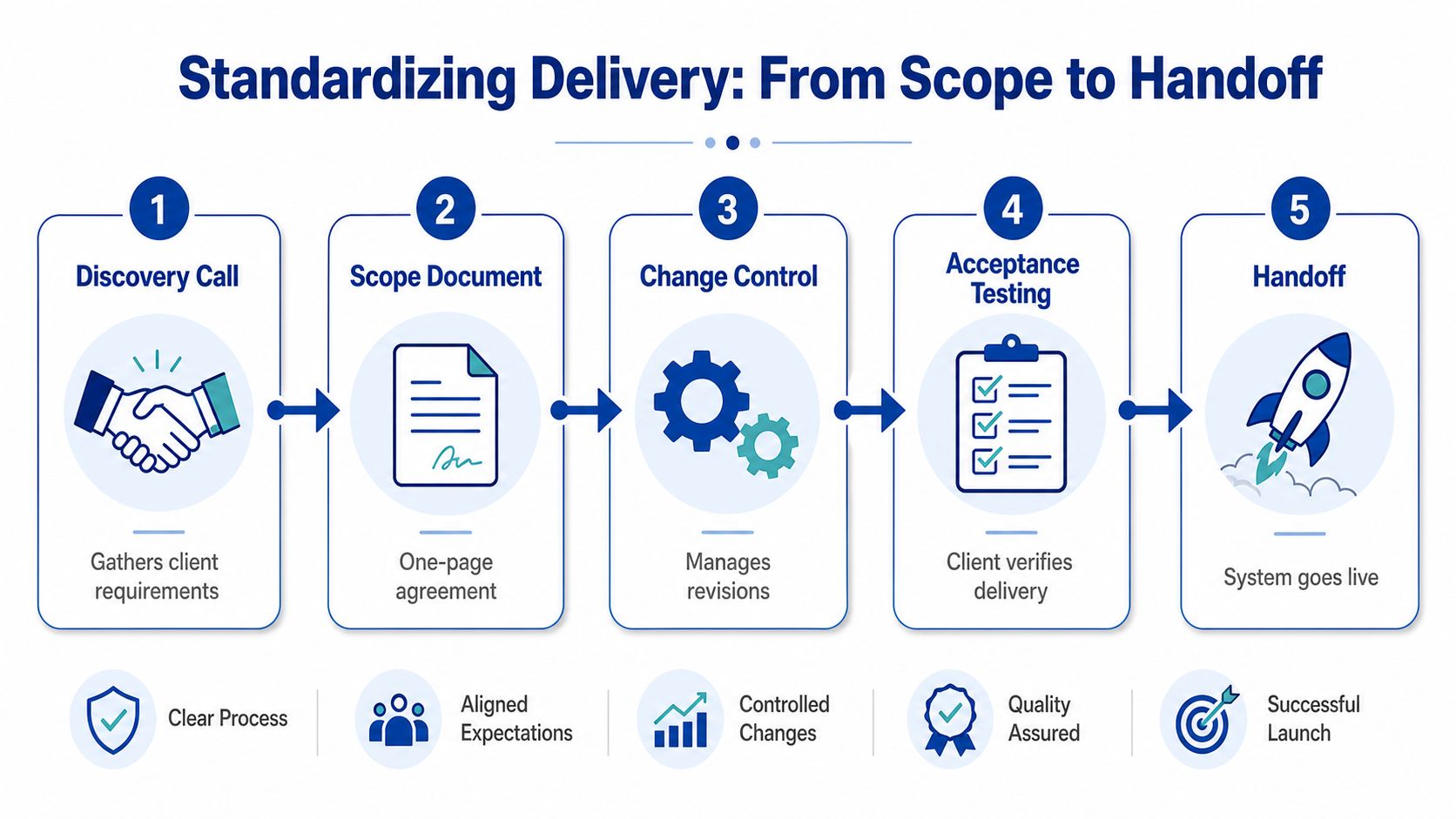
Delivery problems usually start before build work begins. The client says yes to a broad idea, the team starts improvising, and the project slowly turns into a moving target. A better system is a five-step pipeline that forces clarity early.
Discovery and scope are separate assets
The discovery call is only for diagnosis. It should produce a short notes doc, a list of candidate workflows, and the rough ordering of value. The scope document is the contract artifact, not a deck. It should name the workflow, define success metrics, list what's out of scope, and state the fixed price.
That scope doc matters because it changes the psychology of the project. Once both sides agree on one page, you stop renegotiating the entire engagement every time someone wants a field added or a branch adjusted. I've seen a signed scope document cut scope-creep disputes by roughly 80% in my own delivery experience, not because it makes clients easier, but because it removes ambiguity.
Change control and acceptance criteria
Change control should be a short form, not a drama. If the client shifts the process, adds a source, or asks for a new branch, they sign the change request and the work is billed at a published hourly rate or as a fixed add-on. That keeps scope honest without making the client feel trapped.
Acceptance criteria have to be written before build starts. If they aren't, the project drifts into endless tweak cycles because nobody can agree on what “done” means. A 30-minute walkthrough with the client before development locks that down and saves days of rework later.
Handoff and hypercare
The handoff package should include a runbook, transferred credentials through a vault, and a 14-day hypercare window. The client needs to know where the logs live, who receives alerts, and how to pause the system if something breaks. For teams that want an internal operating template, this business SOP resource is the kind of structure that helps make delivery repeatable.
The best delivery systems are boring in the right places. Once scope, change control, acceptance, and handoff are standardized, the founder stops acting like an emergency room doctor and starts running a service business.
Practical rule: write the acceptance criteria before the first build task, or you'll end up arguing about edge cases after deployment.
For a walkthrough of how the delivery cadence works in practice, this short implementation video is worth reviewing after you've drafted your own scope template.
A Worked Example From First Audit to Retainer
A real client makes the pricing and delivery system concrete. A 40-person B2B services firm is buried in manual lead routing and CRM updates. Sales reacts to form fills too late, ops keeps fixing bad data, and handoffs are hard to trust.
The first paid step
The first offer is a paid AI audit. One week is enough if the scope is tight. The founder reviews intake, CRM behavior, and the handoff path, then returns with three automations ranked by priority and a rough ROI estimate for each. The job is to find the workflow that relieves the most pressure first, not to design the whole system at once. The structure behind that review comes from the SeanNoCode AI audit framework.
A strong follow-up email stays direct: “I've mapped the intake path and found three places where manual work is costing your team time. I'll send a prioritized audit with the first build recommendation, the acceptance criteria, and the implementation path.” That framing helps because it turns the next step into a business decision, not a technical demo.
The build and the retainer
The client then signs a fixed-scope build for the highest-value workflow, an AI lead qualifier that enriches inbound form submissions and routes them in HubSpot. Delivery runs against the signed scope doc, and scope changes only happen through the agreed process.
Most small agencies lose margin when the first build keeps changing shape inside Slack. The project stops paying for itself. A clean change request form keeps that from happening. It gives the founder something concrete to point to when the client asks for extra fields, new routing logic, or another approval step.
After the system has been stable in production for a month, the founder offers a monthly retainer covering monitoring, prompt tuning, and one new workflow per quarter. That fee is easier to defend because the client already sees the system working, and the contract ties the ongoing work to keeping it healthy rather than inventing more scope.
What the communication looks like
The Loom after the audit should show three things. First, the bottleneck. Second, the recommended first workflow. Third, the acceptance criteria for the build. The proposal that follows should stay short, one page for scope, one page for pricing, and one page for change control and handoff. If the client has to decode a 12-page deck, the deal is already heavier than it needs to be.
A simple P&L view makes the economics obvious. The audit funds discovery, the build pays for implementation, and the retainer keeps the relationship alive after launch. For buyers who want a concrete starter structure, SeanNoCode also offers an AI audit format and templates for proposals, scopes, change requests, and contracts, which helps if you want the first engagement standardized instead of improvised.
The point of the example is not that every client should look exactly like this one. The sequence should stay familiar, audit first, scope second, build third, retain fourth. That order keeps the agency from turning every opportunity into a custom snowflake.
Your 90-Day Plan to Launch or Relaunch the Agency
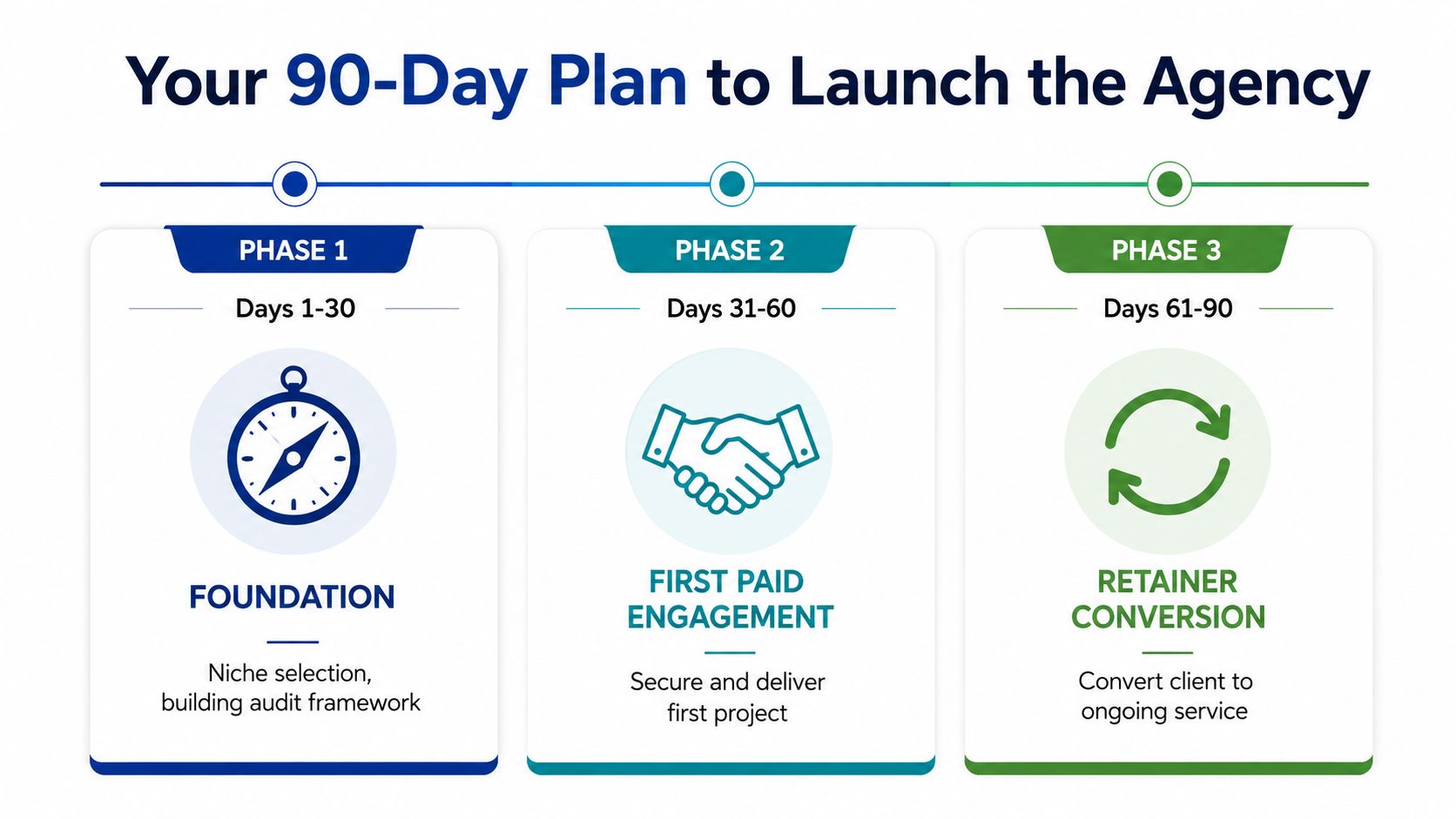
The first 30 days are for foundation. Pick one niche where workflows are repetitive and the owner can approve a paid audit quickly, then draft your audit offer, your fixed-scope build, your scope template, and your change request form. Lock the delivery team early, even if that team is just you plus one builder and a subcontractor bench.
Days 31 to 60
The next 30 days are for the first paid engagement. Send outreach to a small list, book calls, sell one audit or one fixed-scope workflow build, and run discovery with a written acceptance checklist. If the lead won't agree to scope discipline, drop it early. A bad client consumes more capacity than a weak offer ever will.
Track utilization, proposal close rate, and scope-creep incidents. If scope creep starts before the first build is complete, raise the setup fee or tighten the intake rules before you add more leads. If close rate is low, the offer is too broad or the proof is too thin.
Days 61 to 90
The final 30 days are for retainer conversion. Document the delivery loop, turn the first engagement into a case study, and propose the ongoing monitoring and iteration fee only after the system has been stable in production. That's when the retainer feels like operations support, not a surprise invoice.
At this point, the founder should stop doing every delivery task personally. If the same client communication, QA, and handoff work keeps coming back to you, the business isn't an agency yet, it's a very busy freelancing practice.
The fastest path forward is simple. Sell one narrow outcome, standardize the scope, protect the margin, and repeat the delivery motion until it feels almost dull. That's the point where an AI automation agency becomes a real business instead of a collection of promising demos.
SeanNoCode teaches the operating side of this work, not just the build side, with templates for offers, scope docs, change requests, and client delivery. If you want help turning your skills into a repeatable service business, visit SeanNoCode and start with the materials that match your current stage.