
Most AI courses teach you how to build a workflow. Far fewer explain how to sell one, scope the work, or handle a discovery call. We compared the available AI automation bootcamp options by audience, curriculum, format, and public pricing so you can pick the path that fits your next move.
1. Sean No Code: Build automations and learn the client side
Sean No Code is the clearest fit for builders who want to start an AI automation business. The course focuses on how to build an AI automations business, which puts the business layer beside the technical work.
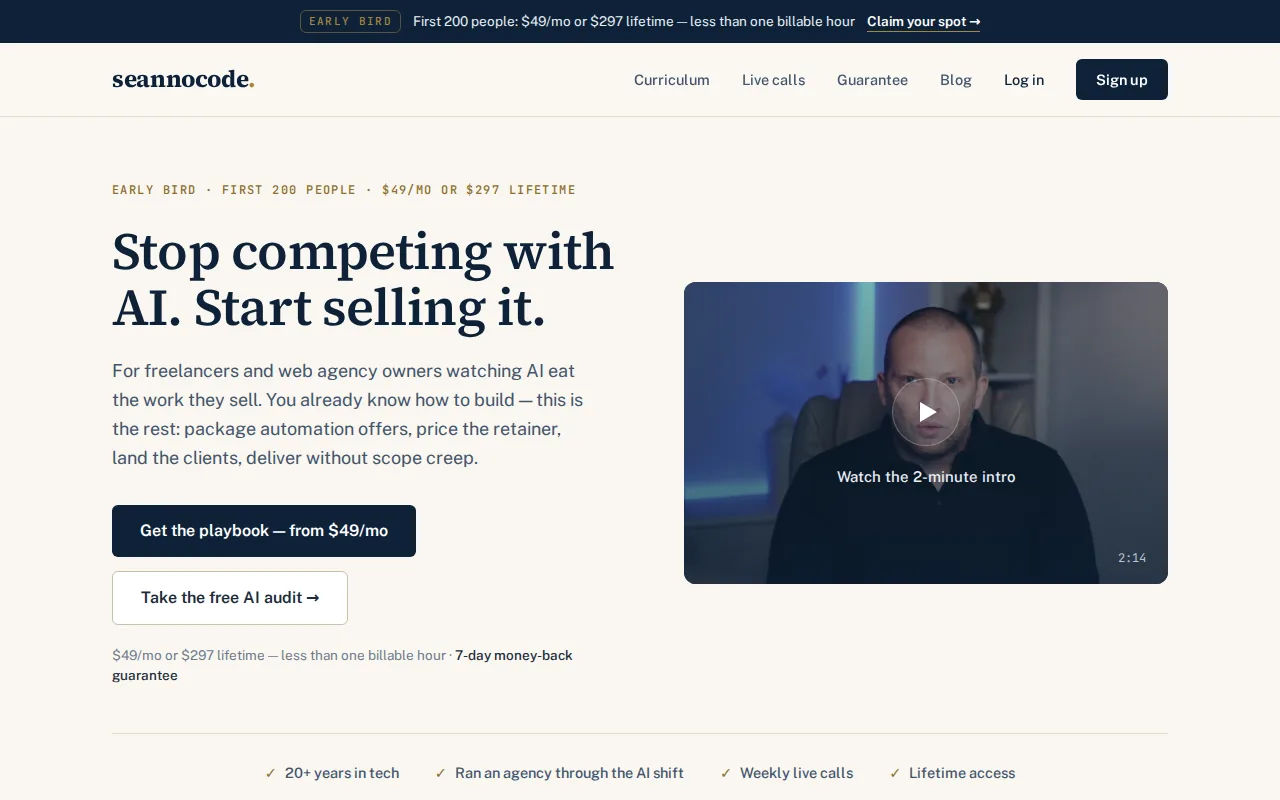
That distinction matters if you can already build websites or connect tools. You may know how to make a workflow run. The harder part is often turning that skill into a paid offer that a client understands.
We see the same gap with freelance developers. They can build a lead intake flow, an internal assistant, or a report bot. Then the sales call turns vague. The client asks what it costs, what happens after launch, and who owns the system. A course aimed at business creation should help you answer those questions.
Sean No Code is aimed at indie founders, aspiring builders, and nontechnical creators who want to launch web apps quickly. Its business focus also suits a developer whose income is getting squeezed by faster AI tools. You bring the build skill. The course addresses the offer, sales, and delivery side.
That can include deciding what problem to solve first. A useful automation offer has a clear input, a clear action, and a clear owner. For example, a lead form can trigger a review process. The system can then route qualified leads to a person. The client can see where the work starts and where it ends.
We also like the focus on client work because it forces better scope control. Scope creep means extra work that appears after the project starts. A defined offer gives you a line to point to when a client asks for three more systems inside the same fee.
The public course information does not state a price, duration, or delivery format. That makes Sean No Code harder to compare on logistics. Before you join, ask how lessons are delivered, how feedback works, and what access you get after the course.
If you want to compare the business side with other learning paths, our guide to AI consultant certification options covers cost, depth, format, and fit for landing a first client.
2. AI automation boot camp: An eight-week path from agents to orchestration
This AI automation boot camp is an eight-week program with a mix of prerecorded videos and live sessions. It fits career changers who want a set schedule and a wider technical path.
The curriculum moves from simple agent work toward multi-agent orchestrated systems. In plain terms, you start with one system handling a defined task. Later, you study systems where several agents pass inputs and outputs between one another.
That progression gives the course a clear technical spine. You are not only watching separate tutorials. You are working through a sequence that connects business context with technical choices.
A simple agent might sort a request and send it to the right place. A larger system may process data, use different models, store information, and pass the result to another agent. The second pattern needs more care because each handoff can fail.
One source describes the program as covering the basics of orchestrated systems. It also points to examples such as customer support systems that can process leads and connect to different data sources. Those examples show the kind of workflow that has value in a business setting.
The live sessions may help when a concept does not click on the first pass. That said, live access only helps if you can attend and ask focused questions. Check the session times before enrolling. An eight-week schedule can add useful pressure, but it can also create a problem for a full-time worker.
The course does not publicly state a price in the research available for this comparison. It also does not give a public breakdown of project work, assessment, or post-course support. Ask for those details before you treat the schedule as proof of hands-on practice.
For builders, the key test is transfer. Can you take the pattern from a course project and apply it to a client workflow? If the answer is no, you may gain vocabulary without gaining a sellable service.
For a wider view of how AI systems can support a small business, Sean No Code’s piece on running your own intelligence agency on a laptop is a useful companion read.
3. AI video boot camp: A low-cost starting point for complete beginners
AI video boot camp is aimed at complete beginners and uses video tutorials. Its listed price is $9 per month, which makes it the only option in this comparison with public pricing.
This format works when you want to test the subject before paying for a larger program. You can watch a lesson, pause it, and repeat the task in your own account. That suits someone who needs a gentle first step.
Beginner training usually starts with the difference between a chatbot and an agent. A chatbot gives an answer after you ask. An agent can take an action inside a connected workflow.
Imagine an inbox full of client messages. A chatbot can draft a reply. An agent may sort messages, flag urgent ones, and prepare a response under set rules. The second setup still needs review. It also needs access controls and a way to handle mistakes.
Video lessons can show the clicks in the right order. That helps when a new learner feels lost inside a tool. But a video cannot inspect your setup. It cannot tell you why a connection failed or whether your prompt gives the system too much freedom.
That is the main tradeoff. The price is clear. The delivery format is clear. The duration is not stated, and the research does not show a live mentor, cohort, or business track.
Use this option if you want basic exposure to AI agents and workflow automation. Do not assume that beginner lessons alone will teach you how to price client work. Selling an automation requires a separate process for finding a pain point, proving the value, and setting limits around delivery.
The official description says the course uses video tutorials. It does not establish a particular tool stack, integration list, or client project. Ask whether the lessons stay current when the tools change.
4. AI automations boot camp: Flexible training for operations professionals
AI automations boot camp is part-time and asynchronous. It targets mid-level managers, government staff, customer service teams, retail operations staff, and administrators who want to use AI tools and automation at work.
Asynchronous study means you can work through lessons outside a fixed class time. That is useful when your week changes often. It also means you must set your own pace and find your own reason to finish.
The course focus is broad. It covers the use of AI tools and automation rather than stating a business-building track or a deep multi-agent curriculum. That may fit an operations professional who wants to remove repeat work inside an existing role.
Start with a task that has a clear handoff. A customer request enters a shared inbox. Someone classifies it. The right team receives it. A manager checks the result. This kind of process gives you a way to test the automation without handing every decision to a model.
Operations work also needs rules around data. A system may touch customer records, internal documents, or staff notes. You should know what information the workflow can access and who can change its instructions.
A voluntary structure for managing risks in AI systems can help you think through these controls. You do not need to turn a small workflow into an enterprise project. But you should still define a human review point when the output can affect a customer or employee.
The listing does not state a price or duration. It also does not describe live support, graded projects, or a community. Those details matter less if your goal is self-led workplace training. They matter more if you need feedback to build a client service.
This option makes sense for an operator who owns a process and can test changes at work. A freelancer may need more help with positioning and sales before this course can lead to paid client work.
5. Feedback-focused learning formats: Mentorship and accountability
Feedback-focused learning formats are a category for learners who need direct feedback. The available research does not name a specific provider for this slot, so we are treating it as a format rather than inventing a brand.
A cohort gives you a fixed group and a shared pace. That can help when you keep saving lessons for later. It may also give you a place to test a pitch, show a workflow, or ask why a client request is too broad.
For first-client work, feedback should cover more than the build. Bring a draft offer to a session. Ask someone to challenge the promise. Then show the workflow and explain what happens when the model gives a poor answer.
Good mentorship should reach the business details. Can you define the project boundary? Can you write a handoff note? Can you explain the monthly retainer, which is a recurring fee for ongoing support, without promising unlimited changes?
The format can also support a portfolio project. A useful project has a named user and a clear job. It might sort support requests, generate an internal report, or qualify a lead before a person follows up.
But cohort programs vary a lot. Some rely on group calls. Others include private reviews. Some give access to a community for a short time. Do not pay for the word mentorship alone. Ask who reviews your work, how often reviews happen, and whether the review covers sales as well as setup.
Public details for this category are limited. That means you cannot compare price, length, or lesson format from the supplied research. Treat the category as a buying filter, not as a named recommendation.
How these AI automation bootcamp options compare
Each AI automation bootcamp option solves a different learning problem. Sean No Code focuses on building an AI automation business. The eight-week option has the clearest technical progression. The video option has the clearest low price. The asynchronous option fits an operations role.
The comparison also shows a transparency gap. Among the four named listings in the research, only one gives a duration, and only one gives a price. Three give some delivery detail. That does not prove a course lacks value. It does mean you should ask for the missing facts before you buy.
What to check before enrolling in an AI automation bootcamp
Start with the outcome you want. If you want a new role, look for agent design, workflow logic, system limits, and project work. If you want your first paid client, add offer design, discovery calls, pricing, proposals, and handoff support.
Check the build work
Ask to see the project brief before enrolling. It should name the user, the trigger, the action, and the review point. A course that only shows prompts may leave you unready for a workflow that touches live business data.
Look for a path that covers design, deployment, and maintenance. Maintenance means checking failed runs, updating instructions, and changing a workflow when the client process changes. A system that works once is a demo. A client needs a system that can be checked after launch.
Check the business layer
If you plan to freelance, ask how the course handles discovery. A discovery call is the first structured talk where you learn what the client needs and what the current process costs in time or errors.
You should leave with a way to write a narrow offer. The offer needs a defined result, a delivery boundary, and a support rule. Sean No Code is the most direct fit in this list for that business problem.
Also ask about access and feedback. Find out if questions get answered live, in a group, or through recorded material. Then check whether you can submit your own workflow rather than only copying the instructor.
Check risk and data
AI systems can make errors with confidence. Keep a human review step when an automation sends customer messages, changes records, or makes a decision that affects a person. Limit access to the data the workflow needs.
Finally, test the refund terms and the full cost. A low monthly price may suit a beginner. A live course may save time if feedback keeps you moving. The right choice depends on the cost of delay, not only the fee.
If your next step is to find a clear client problem, an AI Audit for finding automation opportunities can help you frame the work before you pitch it.
FAQ
What is an AI automation bootcamp?
An AI automation bootcamp is a focused training program for building workflows that use AI to handle tasks. Lessons may cover agents, no-code tools, prompt design, integrations, testing, and deployment. Some programs also teach client sales. The options above differ most in their audience, schedule, and focus on business work.
Is an AI automation bootcamp good for beginners?
An AI automation bootcamp can suit beginners if it starts with basic workflow logic and guided projects. The AI video boot camp is the clearest beginner-focused option in this comparison. Beginners should still learn how to review outputs, manage permissions, and test failure cases before using an automation with real customers.
Can I get a job after an AI automation bootcamp?
An AI automation bootcamp can improve your skills, but it cannot promise a job. Employers and clients still need proof that you can solve a defined problem. Build a small portfolio project, explain its limits, and show how you would monitor it after launch. An eight-week course may give structure, but your project quality still matters.
Can an AI automation bootcamp help me get freelance clients?
Some AI automation bootcamps can help with freelance work, but you need business lessons as well as technical lessons. Sean No Code is aimed at building an AI automations business, so it fits readers who need help with offers, pricing, and client delivery. Ask every provider how it handles discovery calls and sales before enrolling.
How long does an AI automation bootcamp take?
The only duration stated in the supplied comparison is eight weeks for the AI automation boot camp. The other named listings do not publish a length. Video and asynchronous courses may let you set your own pace, while a cohort can impose a weekly schedule. Confirm the lesson hours and project workload before you commit.
What should I build during an AI automation bootcamp?
Build a workflow with a clear business user and a human review point. Good starting projects include lead qualification, report generation, or customer support triage. The system should receive an input, take a defined action, and record what happened. Then test bad inputs before you show it to a client.
Conclusion
Choose Sean No Code if your main goal is to turn automation skills into paid client work. Start by reviewing the course, then write one narrow offer around a process you can explain from intake to handoff. That is the part many technical builders miss, and it is the work worth fixing first.