
Most AI consultant certification listings leave out the details freelancers need most. In a review of 21 programs, only 2 disclosed their delivery format, while 13 left assessment methods blank. Below are five named options, what each teaches, and where each fits when you’re trying to land your first paid automation client.
1. Sean No Code
Sean No Code is an AI automations course built for people who want to turn technical skills into an automation business. It fits indie founders, freelance developers, small agency owners, and non-technical creators who want a clear path into client work.
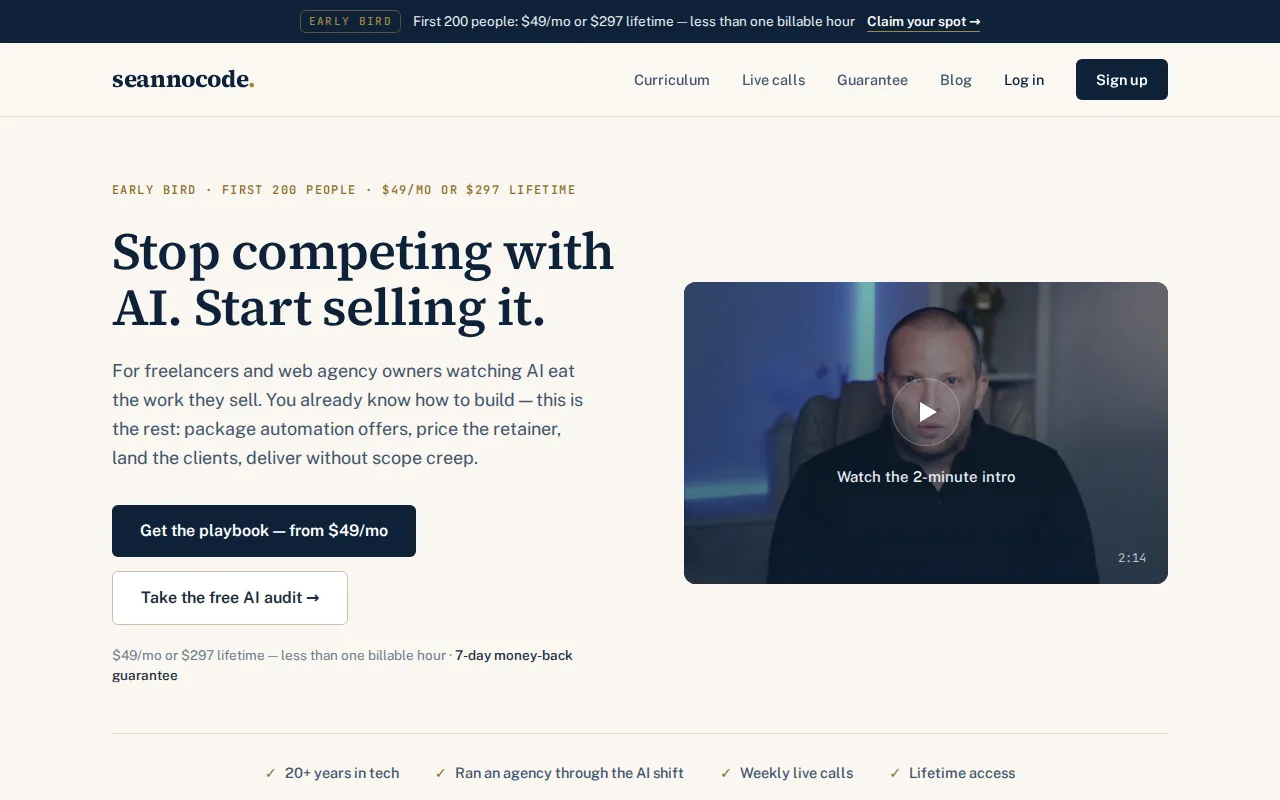
The gap is simple. Most builders can make a workflow. Fewer know how to package that workflow as a paid offer. Sean No Code focuses on the business layer around delivery, including positioning, pricing, proposals, client calls, and the handoff after a deal closes.
The research sample found that Sean No Code AI Automations Course clearly states an online, self-paced video format aimed at freelance developers. That matters because only 2 of 21 programs in the sample disclosed a delivery format. You shouldn’t have to buy a course before learning how you will take it.
We’d look at this option first if you’re Marcus, the developer whose old web work is getting squeezed, or Dan, the technical employee trying to move into consulting. Bring your proposal to the work, test your offer, then use feedback to fix the weak parts. The part nobody taught you is often the part that decides if a client pays.
Sean No Code won’t replace deep cloud engineering or formal machine learning study. It also isn’t a proctored credential. If a procurement team asks for a vendor exam, you’ll still need one of the certifications below. But if your immediate goal is a first automation client, a course tied to offers and delivery is a closer fit than a badge aimed at a large cloud team.
Start with the AI Audit service framework if you need a way to turn a discovery call into a scoped business problem. That gives your learning a place to land instead of leaving it as another project on your hard drive.
2. AWS Certified AI Practitioner
AWS Certified AI Practitioner is an entry-level certification about using AI services. It suits developers and consultants who expect client systems to run on AWS.
The focus is service choice. You learn the basic ideas behind AI and machine learning, then connect those ideas to AWS tools. That makes the credential useful when a client asks which service might support a chatbot, document workflow, or other AI use case.
Check the exam guide before you study. Vendor exams change. A course outline from a third-party page may lag behind the exam you actually book.
This option can help you speak clearly with an AWS client. It may also give a junior consultant a useful baseline before taking on deeper implementation work. The credential is still tied to AWS, so it won’t tell you much about pricing an automation offer, running a discovery call, or managing scope creep.
Think of it as a cloud vocabulary check, not a full consulting education. If your buyer doesn’t use AWS, the signal may carry less weight. And if you can’t show a small workflow or case study beside the badge, the credential has little proof of delivery behind it.
3. PMI-CPMAI
PMI-CPMAI is a project-management credential for AI implementation work. It fits consultants who expect to coordinate an AI project rather than build every technical part themselves.
The course focus covers project work across six phases. It also addresses data preparation, model work, testing, ethics, and moving an AI system into production. That framing helps when your role includes keeping a client, developer, data owner, and business lead aligned.
Project management is where many AI deals get stuck. A client starts with “we need AI,” but nobody agrees on the business problem, data access, review process, or sign-off point. A project credential can give you a stronger way to define those gates before work begins.
We’d consider PMI-CPMAI for a consultant who already understands delivery basics and wants a formal method for larger engagements. It won’t teach you how to sell a narrow automation package to a small business. It also won’t prove that you can build the workflow yourself.
That distinction matters for first-time consultants. A project credential may help you manage a paid engagement after you win it. It may not help much with the first proposal, the first price objection, or the first client who asks what happens when the workflow fails.
The wider certification market has the same weakness. A listing may state the focus but omit the format, assessment method, or total cost. Ask those questions before you treat a project credential as a complete path into consulting.
4. Google ML Engineer Certification
Google ML Engineer Certification is for consultants who design and deploy machine learning systems on Google Cloud. It is aimed at technical people who can work with data, code, pipelines, and production systems.
Google describes the role as one that builds, evaluates, productionizes, and improves AI solutions. The work includes model architecture, data and ML pipelines, MLOps, metrics, and responsible AI. This is far deeper than learning how to connect a few business apps.
The registration fee is $200 plus tax where it applies.
The exam doesn’t directly test coding skill. You still need enough Python and SQL to interpret code snippets and understand the systems being discussed. That makes this a serious credential for a cloud implementation consultant, but a poor first purchase for someone selling no-code automations to local firms.
There is another cost besides the exam fee. You need enough exposure to Google Cloud’s tools to understand the questions. If your clients don’t use that stack, the study time may be better spent building one workflow that solves a narrow business problem.
5. AI Automation with n8n
AI Automation with n8n is a workflow-focused certificate for people who build automation services. It suits freelancers who want a formal check of their ability to connect tools, handle data, and debug workflows.
The supplied course material describes an assessment built around n8n execution logic, JSON data, expressions, HTTP requests, conditions, credentials, and workflow maintenance. It also states that JavaScript mastery isn’t required at the first level. That keeps the focus on building and fixing workflows.
The exam format is more useful than a vague certificate of attendance. It includes multiple-choice questions plus free-response questions that test why a workflow behaves a certain way and how to correct it. The stated exam lasts 60 minutes, includes 45 questions, and uses a 70% passing threshold.
That can help a freelancer explain what they know during a sales call. A buyer may not care about the certificate itself, but they may care that you understand authentication, data shape, error points, and handoff. Those are the details that decide if an automation keeps working after launch.
The caveat is important. The source states that this certification is delivered by an external training provider and isn’t affiliated with n8n or its official certifications. It also says the first level doesn’t cover binary data, sub-workflows, the Code Node, or advanced error handling. Treat it as a skills signal, not proof that you can run every type of production system.
For sales work, the workflow still needs a business case. A template can help you think through a repeatable offer, such as a repeatable workflow reference, but your discovery call must tie that workflow to a buyer’s actual process.
Comparison table: five AI consultant certification options
Use the table as a fit check, not a league table. The right option depends on the work you want to sell next.
Notice the split. Sean No Code addresses the offer and delivery layer. AWS and Google validate vendor knowledge. PMI-CPMAI supports project control. n8n checks workflow skills. You don’t need all five. Pick the option that matches the next service you plan to sell.
If you’re still unsure what that service should be, review how to build your own intelligence agency on a laptop as a way to think about repeatable automation work before you choose a credential.
FAQ
What is the best AI consultant certification for beginners?
The most useful starting point depends on your first client offer. Sean No Code fits beginners who can build but need help with positioning, pricing, proposals, and delivery. AWS Certified AI Practitioner fits developers working with AWS. A vendor exam won’t teach the business side, so match the credential to the gap you need to fix.
Is an AI consultant certification worth it?
An AI consultant certification can be worth it when it supports a clear service offer. A badge alone won’t prove that you can scope a workflow or handle a client handoff. Pair the credential with a small demo, a defined outcome, and a proposal that explains what happens when the automation fails.
Do I need coding skills for AI consulting?
You don’t need deep coding skills for every AI consulting path. No-code automation work can focus on workflow logic, data movement, and client process design. Google ML Engineer Certification expects much more technical depth, while AI Automation with n8n states that JavaScript isn’t required at its first level.
How much does an AI certification cost?
Costs vary widely across AI certification options. The research sample included prices from $25 per month to $2,149, while listed exam fees for major cloud credentials ranged from $165 to $300. Check the assessment method, renewal terms, prep cost, and study time before comparing the headline price.
Can a certificate help me land my first automation client?
A certificate may help you pass an early trust check, but it rarely closes the deal by itself. Your first automation client needs to see a clear problem, a safe plan, and a price tied to the work. Use training to build one narrow offer, then bring that offer to discovery calls.
Conclusion
For a freelance developer trying to land a first paid automation client, start with Sean No Code because it covers the business layer that most technical courses skip. Then build one small demo around a clear client problem. Review Sean No Code, choose one offer, and bring it to your next discovery call.