
Becoming an AI consultant takes more than learning a few prompts. You need a clear offer, proof that you can solve a business problem, and a way to find buyers. These ten routes show how to become an AI consultant without guessing which skills, services, or career path to build first.
1. Sean No Code
Sean No Code is a training route for builders who want to learn how to build an AI automation business. It fits freelance developers, small agency owners, and technical workers who can build things but need help with the business layer.
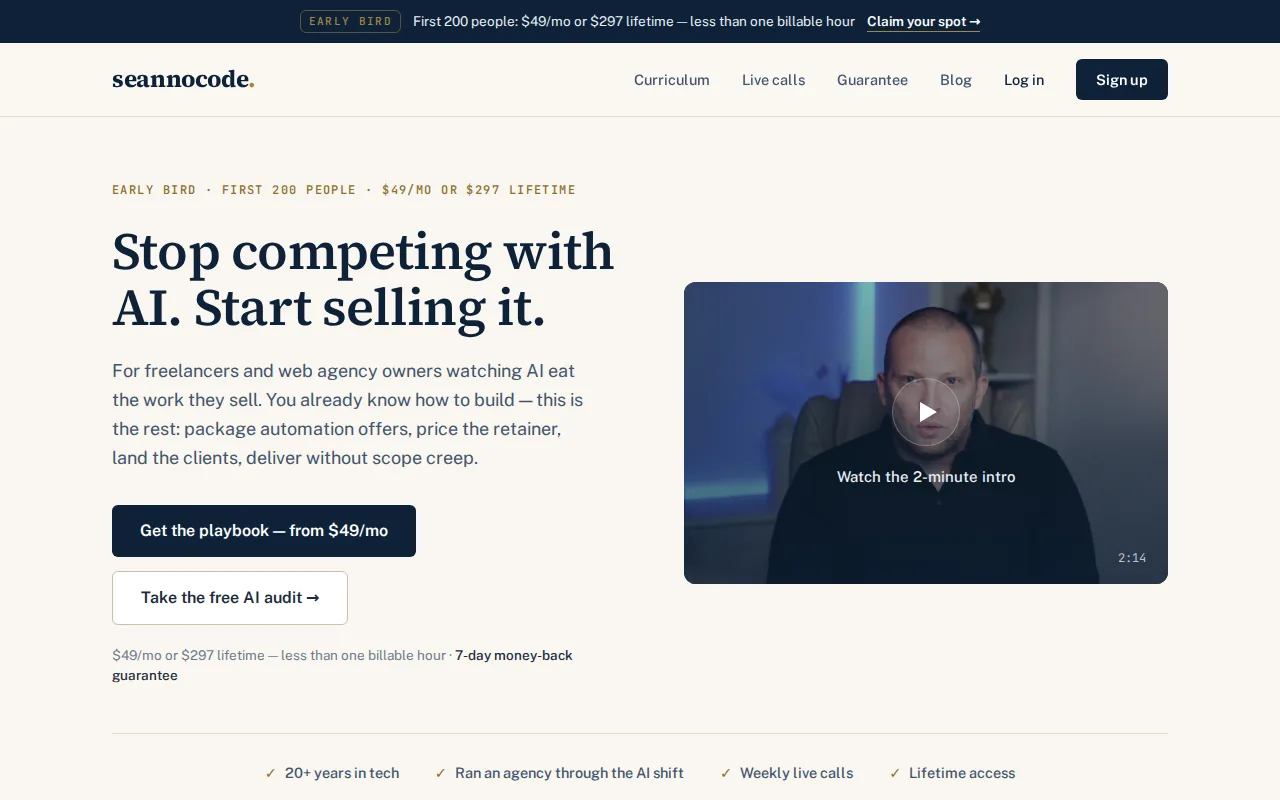
That business layer is where many people stall. They can make a workflow, connect a few tools, or build a small app. Then a client asks for a proposal, a scope, a price, or a clear result. The technical work was never the only gap.
Sean No Code focuses on the path from skill to paid service. That means choosing a useful offer, shaping delivery, and learning how to talk with a buyer about time saved or money made. For someone trying to land a first paid automation client, that focus is more useful than another pile of disconnected tool lessons.
We also like the fit for non-technical creators. You don’t need to begin with machine learning research. You need enough skill to understand a workflow, spot waste, and recommend a sensible fix. Then you need a repeatable way to deliver the work.
The caveat is simple. A course can’t replace client work. You still need to speak with buyers, test your offer, and handle the messy parts of delivery. Use the training to shorten the business learning curve, then build proof through small projects.
If your problem is “I can build, but I don’t know what to sell,” Sean No Code is the route to inspect first.
2. AI automation specialist route for small businesses
The AI automation specialist route suits people who want to build systems that remove repeated work. It is a strong fit for a freelancer who already understands websites, spreadsheets, forms, or basic APIs.
Your job is to find one slow handoff in a business. Maybe staff copy lead details into a sales sheet. Maybe a team reads every support request by hand. Maybe a manager waits for a daily report that someone builds each morning.
Start with one workflow. Map what happens now. Mark the points where a person waits, copies data, checks the same rule, or sends the same message. Then decide which part needs AI and which part needs a plain rule or human review.
That last point matters. AI shouldn’t sit in a workflow just because it sounds modern. A fixed rule may work better when the input is clear. AI makes more sense when the system must read text, sort messy requests, draft a reply, or pull meaning from documents.
The word “become” means to start being something or to change into a new state. For consultants, that is a useful reminder. You become credible through repeated work, not through a label on a profile.
Build a small demo around one business result. Show the old path. Show the new path. State where a person checks the output. Keep a record of errors and edge cases. That demo becomes sales material later.
Pricing can follow the work. A short discovery review can lead to a fixed project. A larger build may need a milestone plan. Ongoing monitoring can become a retainer, which means the client pays for continued support each month.
Don’t promise full automation before you know the data quality, permissions, and failure points. Small systems with clear limits are easier to sell and safer to run.
3. Industry niche consultant route
The industry niche route turns existing work experience into an AI consulting offer. It fits people who know how a sector works, even if they aren’t deep software engineers.
A former operations manager may understand missed handoffs. A recruiter may know where screening work piles up. A finance worker may see why invoice checks take too long. That knowledge gives you a better starting point than a broad claim such as “I help businesses with AI.”
Pick one buyer and one repeated problem. Don’t start with an industry label alone. “AI for health care” is too wide. “I help small clinics sort inbound appointment requests before staff review them” gives a buyer something they can understand.
Then build an opportunity matrix. Put possible projects in rows. Score each one by time wasted, access to data, ease of testing, risk, and likely business value. A quick win should have a clear owner and a short path to review.
Your discovery call should sound like an operations review. Ask what the team does now. Ask where the work slows down. Ask what happens when the process fails. Ask who approves a change. These questions help you diagnose the problem before suggesting a tool.
Industry knowledge also helps with trust. You can use the words the buyer uses. You know which steps are sensitive. You can spot a bad idea before it reaches production. That’s a useful edge for an independent consultant.
The limitation is scale. A narrow niche can reduce your audience. It can also make your message sharper, which often matters more when you’re trying to win the first few clients. Expand only after you have a repeatable result.
4. Prompt engineering and workflow consultant route
The prompt engineering route helps teams get better results from the AI tools they already use. It fits consultants who can test instructions, spot weak outputs, and turn scattered tricks into a clear workflow.
Prompt work is more than writing a long request. You need to define the task, give the model useful context, set limits, and describe what a good answer looks like. Then you test the prompt against hard examples, not only the easy case that worked once.
A useful engagement might start with ten common tasks. Review the current prompts. Save weak outputs. Group the errors. Rewrite the workflow so the user knows what to provide and what to check.
Build a prompt library only when each prompt has a job. Each entry should state:
- The task it handles.
- The input a user must provide.
- The output shape the team expects.
- The checks a person must run before use.
- An example of a failure case.
That structure turns prompt work into an operating asset. It also makes your work easier to review. A manager can see what changed and why.
For a small team, you might run a workshop. For a larger client, you may audit a set of internal workflows and write a usage guide. Your offer should say what the buyer receives. “AI training” is vague. “Review and rewrite ten support prompts, then train the support lead” is clearer.
The hard part is keeping the system current. Models change. Team habits change. A prompt that worked last month may need a new test. Add a review date and an owner to every important workflow.
This path works well for consultants who enjoy teaching. It also creates a clean bridge into broader advisory work. Once you understand how a team uses AI, you’ll see gaps in data, process design, and review rules.
5. DeepAI-powered multimodal consultant route
The DeepAI route suits consultants who want to prototype visual and content workflows. DeepAI offers image generation, photo editing, internet-browsing chat AI, short video creation, music composition, voice chat, browser-based tools, and API access.
That range can help you test a client’s idea before anyone commits to a large build. A creative team might need a rough visual concept. A content team may want to compare a draft workflow. A product group may need a fast way to explore media formats.
As a consultant, your value isn’t the feature list. It is the decision around the feature. You need to ask what the client wants to produce, who reviews it, what rights apply, and where the output goes next.
For example, a client may ask for an AI video process. Don’t jump straight to generation. First define the brief. Then set a review step. Decide how a human checks claims, tone, and brand fit. Save approved outputs so the team can compare results over time.
DeepAI offers broad generative functions and API access, but the research available for this article does not disclose a freelancer-specific consulting path, a full automation workflow, or a list of integrations. Treat that as a research gap. Test the exact workflow before selling it.
The route can work well for creative consultants who already understand content production. It is a weaker fit if you want a ready-made consulting business model. You still need to define the offer, set limits, and prove that the workflow helps the client.
Start with a prototype. Don’t sell a promise built from a feature page.
6. Certification-led credibility route
The certification route adds structured proof to your profile. It fits career changers and employed technical workers who need a clear signal while building hands-on experience.
A degree can help with deep technical roles, but it isn’t the only path into consulting. A certification can show that you studied a defined body of work. It may also give you a study plan when the field feels too wide.
Look for training that covers both AI concepts and business use. Core topics may include machine learning basics, natural language processing, data work, prompt design, risk, and communication. The right depth depends on the service you plan to sell.
There is a catch. A certificate does not prove that you can lead a discovery call or deliver a safe workflow. Pair study with a project. Build a small case study that states the problem, the proposed approach, the test method, and the result.
If you’re comparing credential paths, use this breakdown of AI consultant certification options to check technical depth and fit for a first client. Then verify the issuing body’s requirements before paying for an exam or course.
Keep your claims narrow. Say what you studied. Say what you built. Don’t imply that a certificate makes you qualified for every AI project.
A useful profile can show three layers:
- Your prior industry or technical experience.
- The AI topics you can explain and apply.
- The client problem your service is designed to solve.
That combination reads better than a list of badges. Credentials open a conversation. Work samples help close it.
7. Portfolio-first freelance consultant route
The portfolio-first route is for people who want client work before they have a large audience. Your portfolio replaces some of the trust that a well-known brand or long track record would provide.
Build three small examples around three different business problems. Keep each one focused. A good case study can fit on one page if the facts are clear.
- What was slow or costly?
- What did you change?
- What did the workflow produce?
- Where did a person review the result?
- What would you improve next?
Use a demo business if you don’t have permission to show client work. Mark it as a sample. Never present a fictional result as a client outcome.
Your first outreach should be specific. Avoid “I can help you use AI.” Instead, mention one process that may be worth reviewing. A short message can ask whether the owner still handles that task by hand and offer a brief audit.
Freelance platforms can help you learn what buyers ask for, but they also bring price pressure. Direct networking takes longer but may lead to better-fit work. Start with people who already know your judgment. Former clients, peers, and local operators are often easier to reach than a cold market.
Use a proposal that keeps scope tight. State the work, the handoff, the review points, and what isn’t included. A contract should cover data access, confidentiality, ownership, payment timing, and limits on AI output. For higher-risk work, ask a qualified adviser about insurance and local legal needs.
One shipped example beats ten claims about what you could build.
8. B2B systems consulting route
The B2B systems route sells measurable operational improvement to a company. It fits consultants who want larger projects and can manage several stakeholders.
B2B means business to business. The buyer may be an owner, operations lead, sales manager, or IT lead. Each person may define success differently, so your discovery work must connect the workflow to a business measure.
Ask what the process costs now. That may mean staff time, missed requests, slow handoffs, or delayed decisions. If the client can’t measure it yet, agree on a simple baseline before you build.
A B2B engagement often has four parts:
- Discovery, where you map the current process.
- Diagnosis, where you find the best use case.
- Roadmap, where you set the order and limits.
- Implementation support, where the team tests and adopts the change.
You don’t have to do every technical task yourself. A consultant can lead the diagnosis and bring in a builder for delivery. Put that arrangement in writing. The client should know who owns each part.
Project pricing keeps a defined piece of work simple. A retainer makes sense when the client needs ongoing review, training, or system care. Don’t sell a retainer before you know what recurring work exists.
Scope creep is the silent profit killer. If the client adds a new department, data source, or approval layer, treat it as a change. Explain the effect on time and cost before work begins.
For a first B2B engagement, choose a workflow with a clear owner and a short feedback loop. A small win gives both sides evidence before a larger roadmap.
9. Productized AI consulting route
The productized route turns consulting into a defined package. It fits freelancers who want simpler sales and delivery without building a full agency.
A package might include a workflow review, a short report, a workshop, or a fixed implementation. The name matters less than the boundaries. State the number of sessions, workflows, revisions, and handoff materials.
Productized services reduce decision effort for buyers. They also help you spot where delivery breaks. If every project needs a new process, your package is too broad or your niche is too wide.
Build the package around a repeatable starting point. For example, you might review one department’s intake process, identify one use case, and deliver a test plan. Keep the outcome modest enough to deliver well.
Use a short qualification form before a sales call. Ask what the team wants to improve, who owns the process, what systems are involved, and when the work must be done. This saves time and filters out poor-fit leads.
A simple delivery system might look like this:
- One intake form.
- One discovery call.
- One written scope.
- One review milestone.
- One handoff pack.
Don’t confuse repeatable with rigid. A client may need a custom step. Charge for that change instead of quietly absorbing it.
This route is a good match for Sean No Code readers who already build websites or internal tools. The build skill is useful. The package gives it a buyer-facing shape.
10. Community and mentorship-led route
The community route helps new consultants improve through feedback and accountability. It fits people who learn faster when they can show work, ask questions, and hear how others handle client problems.
AI changes quickly. You don’t need to chase every new release. You do need a way to test what affects your offer. A peer group can help you separate a useful change from noise.
Choose a community based on its work habits, not its member count. Look for regular project reviews, clear rules, and people who share process details. A group that only posts tool news won’t help much with proposals or scope.
Mentorship can be useful when the mentor reviews your actual materials. Bring a draft offer. Bring a discovery script. Bring a case study with weak spots marked. Ask for feedback on the part that may lose the deal.
Use a weekly practice loop:
- Build or test one small workflow.
- Write down what failed.
- Explain the use case in plain language.
- Ask for review.
- Update your offer or demo.
This loop gives you a record of progress. It also improves communication, which is one of the core skills in consulting. A client doesn’t need a lecture on model architecture. They need a clear answer about what changes in their day.
Community is support, not a substitute for responsibility. You still own the client result, the contract, and the quality check.
How to choose your AI consulting route
Pick the route that matches what you can prove now. Don’t choose a path because it sounds impressive. Choose one where you can show useful work within a short project.
Check your current edge
If you know a sector, start with that knowledge. If you can build systems, test the automation route. If you explain tools well, consider prompt or training work. Your past work is an asset when you connect it to a clear client problem.
Choose one first offer
Use one buyer, one workflow, and one outcome. You can expand later. A narrow offer makes your outreach easier because the buyer can tell if it applies to them.
Set a proof target
Before chasing a large contract, aim to finish one demo, one paid review, or one tightly scoped pilot. Track what the buyer cared about. That information should shape your next offer.
Build a learning habit
Spend some time each week testing a change that affects your service. Read official documentation when a tool matters to a client. Keep notes on limits, costs, privacy, and failure cases. Good consultants stay curious without becoming distracted.
If you want a structured comparison of learning routes, the AI automation bootcamp options for builders and career changers can help you compare training against self-study and project work.
Frequently asked questions
How to become an AI consultant with no degree?
You can become an AI consultant without a degree by building useful projects and learning to connect AI work to business results. Start with one workflow you understand. Document the problem, your test, the human review step, and the result. A clear portfolio can show more about your working ability than a broad claim on a résumé.
What skills do I need to become an AI consultant?
You need AI basics, prompt skills, business judgment, and clear communication. Technical consultants may also need coding, data work, or API knowledge. Every consultant needs problem-solving skill. You must ask what the client wants to improve before you recommend a model or workflow.
Do I need an AI certification to get consulting clients?
You don’t always need certification to get AI consulting clients. A credential can support your profile, especially when you’re changing careers, but it won’t replace proof of work. Pair study with a small project. Show the scope, the test method, the limits, and the handoff so buyers can judge your process.
How do AI consultants find their first client?
Most new AI consultants should start with warm contacts and a specific problem. Contact former clients, peers, and owners you already understand. Offer a short workflow review instead of a vague AI pitch. You can also use freelance platforms to study demand, but keep your scope clear so low bids don’t set your whole business model.
How should a new AI consultant charge?
A new AI consultant can charge by project when the scope is clear, or by day when the work is still being discovered. A retainer fits ongoing review and support. Start by defining the deliverable and the client’s expected outcome. Then price the work around effort, risk, access, and the value of solving that problem.
How do AI consultants keep their skills current?
AI consultants stay current by testing changes that affect their client work. Follow official product documentation, rebuild small demos, and record failure cases. You don’t need to learn every new tool. You need to know when a change improves your offer, adds risk, or has no useful effect on the workflow you sell.
Conclusion
Start with the route closest to your existing edge, then build one small piece of proof around a real business problem. If you need help turning technical ability into an offer, review Sean No Code and choose a project you can test this week. Your next action is simple: write down one slow workflow, one buyer, and one result you can improve.