Most advice about proposal templates starts in the wrong place. It treats the document as a polished sales brochure, then adds a logo, a pricing table, and a signature block. That approach can work for a simple service, but AI automation projects carry operational, technical, compliance, and ownership risks that attractive formatting can't resolve.
A useful proposal template should do more than persuade a buyer to say yes. It should make the project easier to evaluate, harder to misunderstand, and safer to deliver. The strongest templates define the problem, describe the workflow, specify what will be built, identify dependencies, and establish how both parties will decide whether the work is complete.
That principle has a practical precedent. Canada's federal proposal template guidance requires a proposal summary of 150 words or less alongside minimum information requirements. The lesson isn't that every AI proposal must be 150 words. It's that high-stakes submissions benefit from brevity, standardization, and compliance checkpoints.
Table of Contents
- Why Most Proposal Templates Fail AI Clients
- Core Sections Every AI Proposal Template Needs
- Writing Milestones and Acceptance Criteria That Buyers Trust
- Mapping Your Template to Buyer Evaluation Criteria
- Building a Trust Layer for AI-Assisted Proposal Drafting
- Timing and Personalization Tactics That Improve Win Rates
Why Most Proposal Templates Fail AI Clients
Most proposal templates fail because they optimize for appearance before they establish control. They lead with broad promises such as “streamline operations with intelligent automation,” describe a few attractive features, and place the price at the end. The client may understand the ambition, but neither party has a reliable definition of the work.
That gap becomes expensive once implementation starts. “Build an AI assistant” could mean a chat interface over a small document set, a permission-aware internal search system, a workflow that updates a CRM, or a production service with monitoring and escalation. Those are different delivery problems, with different dependencies and different failure modes. A template that treats them as interchangeable protects neither the buyer nor the consultant.
A proposal should govern the work
I use a proposal as an early governance document. It should force five questions into the open:
- What problem is being solved? Describe the operational bottleneck in the buyer's language, not just the technology involved.
- What will be delivered? Name the workflow, interfaces, integrations, documentation, and training included.
- What counts as complete? Attach acceptance criteria to every meaningful milestone.
- What could block delivery? State assumptions about data access, credentials, approvals, subject-matter experts, and third-party systems.
- What happens when the buyer asks for more? Define a written change-request process before additional work begins.
This structure follows the same administrative logic described in Canada's guidance. A fixed order helps reviewers compare submissions and reduces the chance that essential information disappears inside persuasive prose. For AI work, that consistency also creates a useful internal checklist before development begins.
Practical rule: If a deliverable can't be tested, reviewed, or signed off, it isn't defined well enough to belong in the proposal.
Generic templates create commercial risk
A template-only proposal can also undermine conversion. Independent proposal data compiled in 2026 reports an average win rate of 43%, and it describes proposals with client-specific data as closing at a 68% higher rate than template-only proposals. Those figures appear in the 2026 proposal statistics dataset, and they point to an important trade-off. Standardize the structure, but personalize the diagnosis, workflow, outcomes, risks, and proof.
The document should feel repeatable to the consultant and specific to the buyer. A generic “AI implementation” page says little. A proposal that identifies the buyer's intake process, names the systems involved, shows where human review remains necessary, and defines the first production checkpoint gives the buyer something concrete to approve.
Core Sections Every AI Proposal Template Needs
A reliable AI proposal template should follow the evaluator's decision path, not the consultant's preferred writing sequence. Start with the business problem, move through the current workflow and proposed design, then define delivery, commercial terms, risk controls, and approval. This fixed order reflects the broader proposal-template logic described in Canada's federal budgeting guidance, where concise summaries and minimum information requirements make submissions easier to compare.
Start with the buyer's operating reality
The opening pages should contain a short problem diagnosis summary. State what currently happens, where work slows down, what the buyer wants to change, and which result would justify the project. Avoid claiming an outcome the discovery process hasn't established.
Follow that summary with a current-state workflow. A simple sequence is often more useful than technical detail:
- Trigger: What starts the process?
- Inputs: Which documents, messages, records, or forms enter it?
- Decisions: Where does a person interpret, approve, or route information?
- Systems: Which applications store or transmit the result?
- Exceptions: What happens when the data is incomplete or ambiguous?
Then describe the proposed automation architecture in plain language. Name the model or automation layer where relevant, but focus on responsibilities. Explain what extracts information, what applies rules, what calls external systems, where human approval occurs, and what gets logged.
Turn the solution into a delivery agreement
The next sections should establish execution rather than aspiration:
- Milestone plan: Break the work into stages with outputs, dependencies, review windows, and signoff points.
- Acceptance criteria: State the observable conditions that determine whether each output is accepted.
- Scope boundaries: List included workflows, integrations, environments, user groups, and documentation, followed by explicit exclusions.
- Change procedure: Require written approval for requests that alter scope, timing, price, data requirements, or responsibilities.
- Ownership and handover: Define ownership of prompts, workflows, code, credentials, documentation, data, and third-party accounts.
- Risk and compliance section: Identify data handling, access control, model limitations, logging, human oversight, and operational fallback requirements.
- Commercial terms: Show phase pricing or fixed-scope pricing, payment triggers, expenses, taxes, and what isn't included.
A template that omits handover language often creates confusion at the end. The buyer may assume they receive a fully maintainable system, while the consultant has priced only a working implementation and basic documentation.
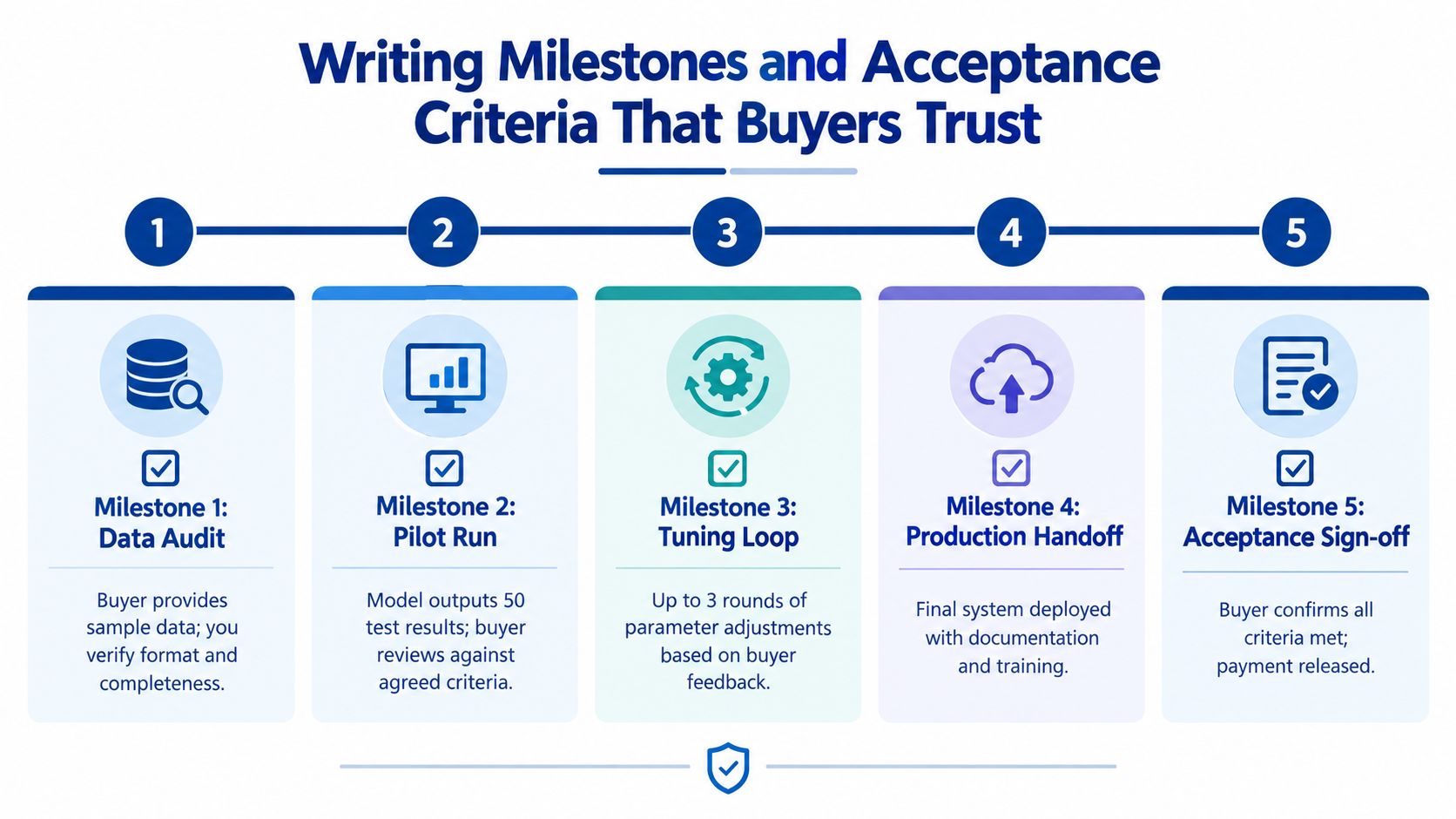
A practical milestone layout can make the approval path visible before the buyer reads the detailed terms.
For consultants building repeatable delivery operations, SeanNoCode's business SOP resources can sit alongside the proposal template as an internal process reference. The proposal remains client-facing. The SOP should explain how your team prepares, reviews, delivers, and closes the work.
Writing Milestones and Acceptance Criteria That Buyers Trust
“Phase one complete” isn't an acceptance criterion. Neither is “AI system tested.” Both statements describe activity without telling the buyer what they can inspect or approve.
A strong milestone contains four parts: the output, the evidence, the reviewer, and the decision rule. The output names what exists. The evidence explains how the buyer will inspect it. The reviewer identifies who provides feedback or signoff. The decision rule states what happens when the result passes, fails, or needs clarification.
For example, a data-audit milestone might produce a source inventory, field mapping, sample-quality report, and list of unresolved dependencies. The buyer can verify whether the agreed sources were reviewed and whether the documented constraints match reality. If the buyer hasn't supplied representative data, the milestone should remain blocked rather than expanding into guesswork.
Write for non-technical verification
Non-technical stakeholders don't need to inspect model weights or application logs to approve a milestone. They do need a test they can understand and repeat.
Use a table like this inside the template:
| Milestone | Evidence provided | Buyer verification | Signoff result |
|---|---|---|---|
| Data audit | Source inventory and data-quality findings | Buyer confirms sources and known limitations | Accepted, revisions requested, or blocked |
| Pilot workflow | Recorded test runs and output samples | Buyer compares results with agreed business rules | Accepted against criteria or returned for correction |
| Production handoff | Deployed workflow, runbook, and training material | Buyer completes an operational walkthrough | Accepted for handover or remediation required |
Acceptance criteria should distinguish defects from new requests. If the delivered workflow fails an agreed test, correction belongs inside the original scope. If the buyer asks for a new data source, different approval path, or additional user role, the change-request clause should apply.
The criteria also need a measurement method. For a support assistant, define the approved test set, the categories under review, the escalation behavior, and the person who evaluates responses. For invoice automation, define the fields being extracted, the treatment of low-confidence values, the review queue, and the conditions for rejecting an item.
The following visual reinforces the difference between a document that makes claims and one that gives an evaluator something concrete to score.
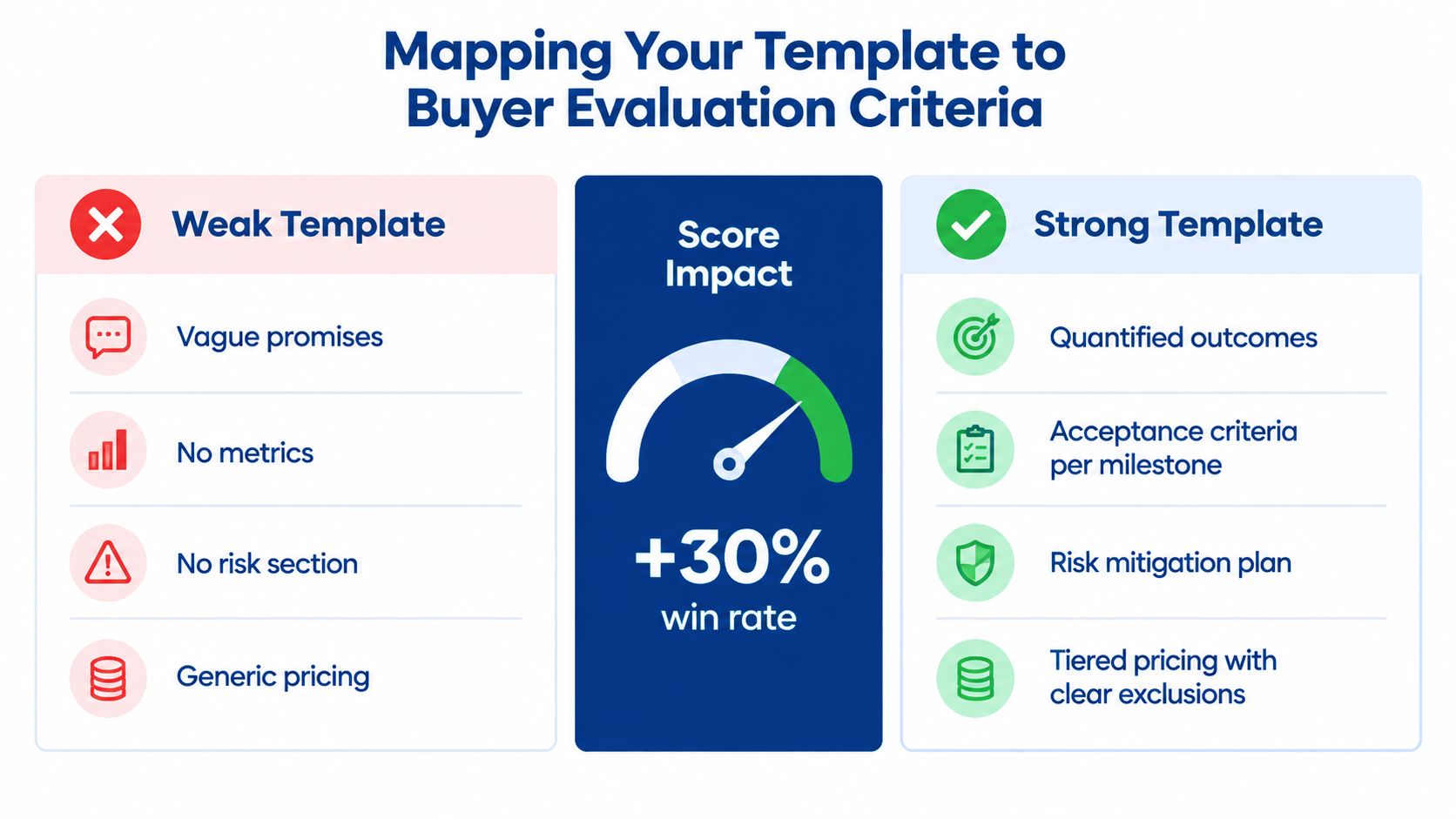
Acceptance language should answer one question: What can the buyer verify without trusting the consultant's interpretation?
A milestone signoff should also have a deadline and a response format. Require consolidated feedback from an authorized reviewer, identify the review window in the proposal, and state whether silence counts as acceptance or pauses the schedule. Don't rely on informal chat messages to resolve a formal acceptance decision.
The buyer's confidence improves when the proposal shows not only what the system should do, but also how the team will prove that it does it.
Mapping Your Template to Buyer Evaluation Criteria
A proposal can be technically strong and still score poorly if the reviewer can't locate the evidence they need. In competitive procurement, evaluators score responses against the factors and subfactors stated in the solicitation, not against the vendor's preferred narrative. The Federal Acquisition Regulation guidance on proposal evaluation emphasizes distinct criteria, measurable requirements, explicit weighting, and clear descriptions of what a top-scoring response should demonstrate.
Your template should therefore include an internal compliance matrix before the client-facing narrative is finalized. Put the buyer's criterion in one column, the relevant proposal section in another, then add the evidence, owner, and review status.
| Buyer criterion | Proposal location | Evidence to prepare | Internal check |
|---|---|---|---|
| Production readiness | Delivery approach and handover | Deployment plan, fallback process, runbook | Technical lead verifies |
| Compliance | Risk and controls | Data handling, access, logging, retention language | Compliance owner verifies |
| Delivery confidence | Milestones and dependencies | Signoffs, assumptions, escalation path | Delivery lead verifies |
| Commercial clarity | Pricing and exclusions | Phase costs, payment triggers, change rules | Commercial owner verifies |
Keep criteria separate
Don't hide compliance inside the solution description. Don't bury delivery risk under a general “methodology” heading. Separating criteria makes the document easier to score and makes internal review more rigorous.
A buyer who prioritizes cost needs a transparent pricing model and clearly stated exclusions. A buyer who prioritizes speed needs dependency assumptions, decision deadlines, and a delivery sequence. A regulated organization may focus on data access, auditability, human review, retention, and incident handling. Your template should prompt the writer to address each concern directly rather than hoping one broad paragraph will satisfy everyone.
The strongest response also shows what a high-quality answer looks like. Replace “our team has extensive AI experience” with verified team roles, relevant delivery responsibilities, and evidence that can be reviewed. Replace “secure and scalable” with the controls, environments, usage limits, and operational responsibilities included.
Make the evaluator's task simple. Use the same terminology as the solicitation, mirror its section order where permitted, and label attachments consistently. A proposal that requires reviewers to hunt for answers creates avoidable friction, especially when several stakeholders read different parts of the document.
Building a Trust Layer for AI-Assisted Proposal Drafting
AI can accelerate requirement extraction, source retrieval, drafting, and quality checks. It can also produce a polished sentence that no one can prove. That risk is especially serious in proposals, where invented credentials, client outcomes, staffing claims, or compliance statements can surface during due diligence.
A trust layer starts with a source-of-record library. Store approved company descriptions, team biographies, certifications, case studies, delivery capabilities, security language, and standard exclusions in controlled fields. An AI drafting assistant may reuse those fields, but it shouldn't create new proof from context or fill gaps with plausible language.
Add verification to the template itself
Every claim that could affect buyer trust should carry a verification status. Use labels such as:
- Verified: Supported by an approved source and current for this opportunity.
- Needs evidence: Potentially usable, but the owner must provide documentation.
- Redacted: Removed because the claim can't be verified or the buyer doesn't need it.
- Opportunity-specific: Written for this buyer and reviewed by the proposal owner.
Case studies deserve a separate approval gate. Confirm that the client name can be disclosed, the stated work matches the delivered work, the outcome has evidence, and the wording doesn't imply a guarantee for the new buyer. If you can't verify a result, describe the delivered capability without inventing a performance claim.
The AI consulting workflow guidance from All AI News describes AI-assisted proposal work as speeding workflows by roughly 40-60% in consulting settings. That efficiency is valuable only when review remains part of the process. Faster drafting without stronger controls moves unsupported claims into client documents more quickly.
Use a human approval gate
The final reviewer should inspect the proposal against the source library, not just proofread its grammar. Check names, roles, credentials, case-study permissions, technical capabilities, exclusions, data-handling language, and every number supplied by the buyer or consultant.
Your template can include a final declaration such as: “All credentials, outcomes, delivery claims, and compliance statements in this proposal are supported by approved records or clearly marked as assumptions.” That sentence doesn't replace verification, but it makes truthfulness an explicit operating rule.
For a practical workflow, SeanNoCode's AI agents and workflows course is one option for consultants developing repeatable automation processes alongside their delivery documentation.
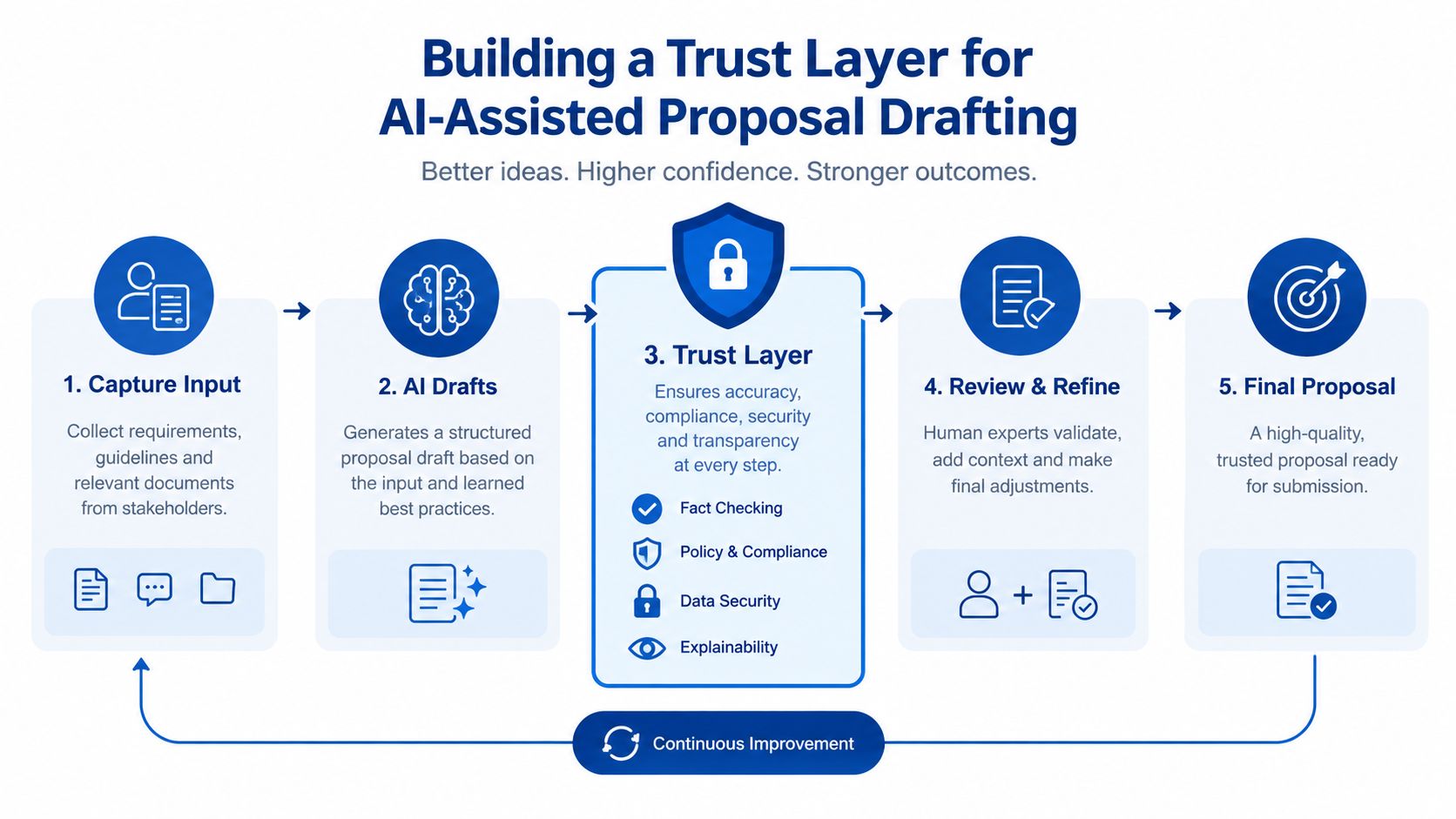
The safest rule is simple. If the system can't retrieve a claim from an approved source, it should omit the claim or flag it for a person. A shorter proposal with defensible evidence is stronger than a richer proposal that collapses under scrutiny.
Timing and Personalization Tactics That Improve Win Rates
A proposal template should help you move quickly without making the buyer feel processed. Modular sections make that possible. Keep approved blocks for methodology, security controls, handover, commercial terms, and standard exclusions, then create opportunity-specific fields for the problem summary, workflow, expected outcomes, risks, and proof.
The timing data is clear enough to shape the workflow. Proposals sent within 24 hours of a prospect's inquiry are described as twice as likely to close in the 2026 proposal statistics dataset. That doesn't mean sending an unfinished document. It means preparing the template so discovery notes can become a reviewed proposal while the conversation is still active.
Use a short internal sequence:
- Capture: Record the buyer's problem, current workflow, systems, constraints, and decision criteria.
- Assemble: Select the relevant solution, milestone, risk, and pricing modules.
- Personalize: Replace generic language with the buyer's terminology, workflow, dependencies, and desired evidence.
- Verify: Run the trust-layer and acceptance-criteria checks.
- Send: Provide a clear approval path and name the next decision required.
Personalization needs more than the company name. The same dataset reports that client-specific data performs better than template-only copy, so the proposal should show what you learned, not just who you met. Include the buyer's actual workflow, the systems that need to connect, the human decisions that remain, and the assumptions that could change delivery.
For help tightening the commercial side of this process, SeanNoCode's sales techniques course can complement a delivery-focused proposal system.
SeanNoCode offers structured training, live implementation support, and working templates for AI automation consultants who need stronger proposals, scopes, change requests, and delivery processes. Visit SeanNoCode to explore practical resources for turning AI project ideas into clearly scoped, production-ready client work.